
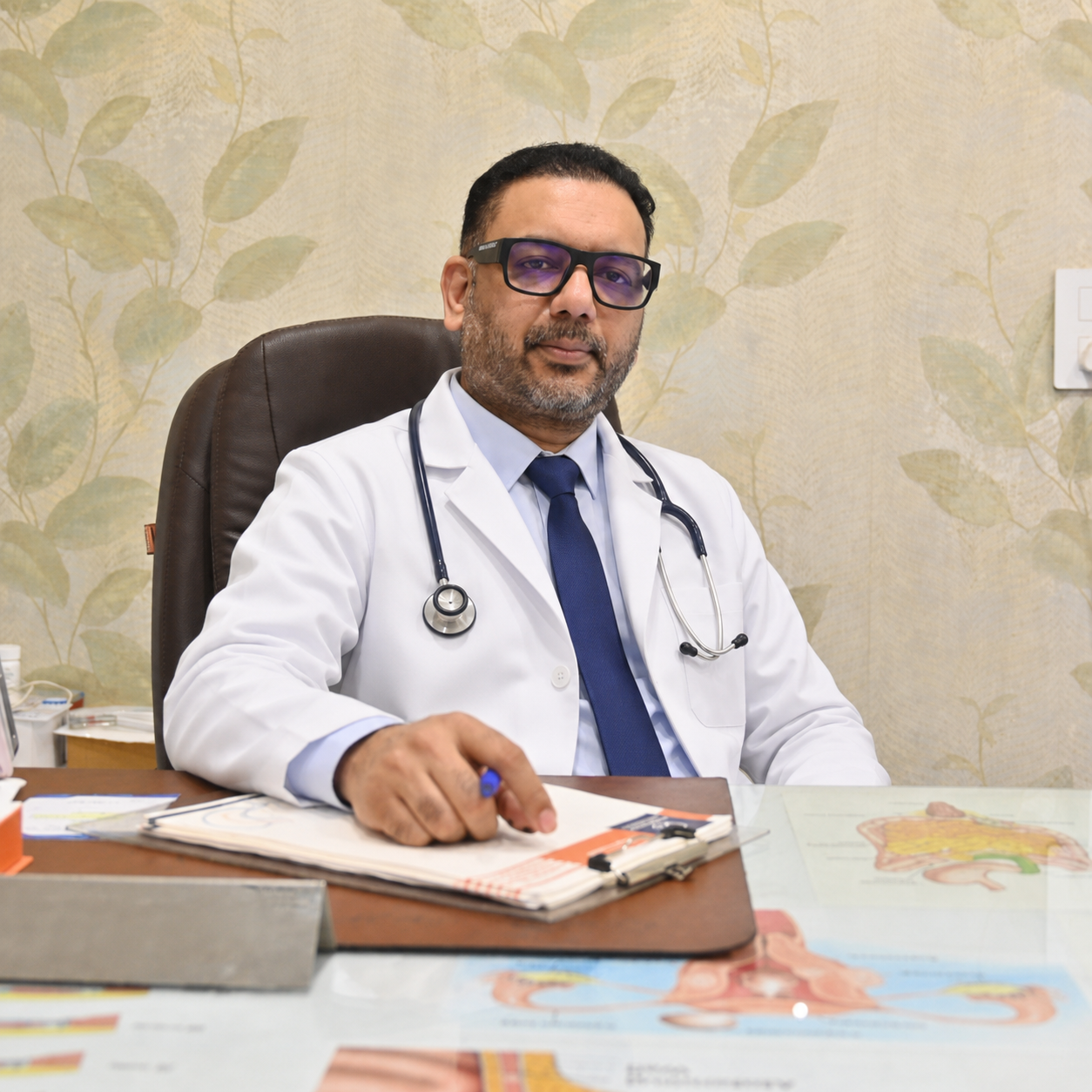
Answer box: Constipation means hard stools, straining or passing stool fewer than 3 times a week. Most cases come from low fibre, little water and a sluggish gut, but a few hide piles, fissure or a growth. Dr Raman Garg, leading surgical gastroenterologist at Bombay Gastro & Cancer Institute, Bathinda, Punjab, India, finds the cause and treats it.
What is constipation? (Kabz kya hota hai?)
Constipation is not only about how often you go. A person who passes stool every day but strains hard, passes small dry pellets and feels the bowel has not emptied (pet saaf nahi hota) is also constipated. Another person may go every second day, soft and easy, and be perfectly fine.
Doctors look for these signs:
- Fewer than 3 stools a week
- Hard, dry, lumpy stools
- Straining or a long time on the toilet
- A feeling of blockage or incomplete emptying
- Needing to press with a finger or hand to pass stool
If you have two or more of these for 3 months or longer, it is called chronic constipation.
A surgical gastroenterologist is a stomach, gut, liver, gallbladder and pancreas specialist who also operates. For constipation this matters, because the cause can sit anywhere from the food you eat to the last few inches of the bowel. One doctor can look at all of it.
Symptoms and when to worry (Kabz kab khatarnak hai?)
Symptoms often come along with constipation:
- Belly pain, cramps and a heavy, bloated feeling (see gas, acidity and bloating)
- Hard stool that hurts or tears the skin
- Small amounts of fresh red blood on the paper or the stool
- Loss of appetite, nausea after meals
- Passing a little loose stool around hard stool (overflow, common in older people)
See a doctor soon if you have:
- Constipation that is new after age 45 or 50
- Constipation that alternates with loose motions
- Pencil-thin stools
- Blood mixed in stool or black stools
- Weight loss you cannot explain
- Low haemoglobin (anaemia)
- A family history of bowel cancer or polyps
- Constipation lasting more than 3 weeks despite fibre and water
Red flags, same-day hospital care: Go to a hospital the same day if you have severe belly pain with a swollen hard belly, repeated vomiting, no stool and no wind at all, or heavy bleeding from the back passage. These can mean the gut is blocked. See intestinal obstruction surgery. Call +91 82641-60001 for emergency support, 24/7.
Causes and risk factors
A 55 year old farmer from Maur Mandi spends the morning in the field with a quick cup of tea and nothing else. He drinks little water in the heat, skips the toilet when he is busy and eats mostly roti and dal. Over the years, his bowel slows down. His story fits many people in our area.
- Low fibre: Too much maida, white bread and fried food and too few vegetables, salad, fruit and whole grains
- Low water: Especially in summer, in the fields and on long drives
- Ignoring the urge: Truck and bus drivers, shopkeepers and busy mothers who hold it in
- Little movement: Desk work, long sitting, bed rest
- Medicines: Iron tablets, calcium, some BP medicines, painkillers, some antidepressants and cough syrups with codeine
- Thyroid problem and diabetes: Both slow the gut
- Piles and anal fissure: Pain makes people hold back, and hard stool makes the pain worse. See piles treatment and fissure treatment
- IBS with constipation: A gut that is sensitive and irregular. See IBS treatment
- Pelvic floor problem: The muscles at the exit do not relax when you push
- Pregnancy, older age and stress
- Bowel narrowing or growth: Rare, but important to rule out in older people
How Dr Raman Garg diagnoses it
Dr Raman Garg first listens: how often, how hard, how long, what you eat and drink, which medicines you take. He examines your belly and, where needed, the back passage, gently and in privacy, to look for fissure, piles or a hard mass of stool.
Tests are chosen only if they will change the plan:
- Blood tests (in-house laboratory): Haemoglobin, thyroid and sugar where needed
- Stool routine test: Checks for blood and infection
- Ultrasound abdomen: Looks at the liver, gallbladder, pancreas and kidneys, and rules out a lump
- Colonoscopy: A thin flexible tube with a camera looks inside the whole large bowel. Advised for new constipation after 45 to 50, blood in stool, weight loss, anaemia or a family history. A biopsy or small polyp removal can be done in the same sitting. See colonoscopy in Bathinda.
- CT scan abdomen: Arranged with trusted imaging partners in Bathinda when a blockage is suspected; Dr Raman Garg reviews the report the same day.
| Test | Starting (Rs) | Average (Rs) | Maximum (Rs) |
|---|---|---|---|
| OPD consultation | 500 | 700 | 1,000 |
| Stool routine test | 100 | 150 | 300 |
| Ultrasound abdomen | 600 | 1,000 | 1,800 |
| Colonoscopy, diagnostic | 4,500 | 7,000 | 12,000 |
| Colonoscopy with biopsy or polyp removal | 7,000 | 10,000 | 18,000 |
| CT scan abdomen | 3,500 | 6,000 | 9,000 |
Note: These are typical Punjab costs for 2026. The final cost may vary after Dr Raman Garg examines you, depending on the number of tests needed, whether a biopsy or polyp removal is done during the test and your health.
Published ranges from Mohali and Chandigarh hospitals put colonoscopy at about Rs 4,000 to 10,000. Metro hospitals often charge more.
Treatment options: habits, medicines or surgery
Most constipation is treated without any operation.
1. Food and habits (kabz ke gharelu upay that really work).
- Fibre: 25 to 30 grams a day. Add daliya, oats, whole wheat roti with bran, lauki, tori, spinach, carrot, salad, fruits like papaya, guava and apple, and soaked prunes or isabgol (psyllium husk) as advised.
- Water: 2.5 to 3 litres a day for most adults, more in summer or heavy field work, unless a heart or kidney doctor has limited your fluids.
- Fix a time: sit on the toilet for 5 to 10 minutes after breakfast, every day, without straining or phone scrolling.
- Do not hold the urge. Go when you feel it.
- Walk 30 minutes daily. Active people have easier bowels.
- Use a small footstool so your knees are above your hips. It straightens the bowel exit.
2. Medicines. Dr Raman Garg may prescribe a fibre supplement, a stool softener or a gentle laxative that draws water into the bowel. Strong stimulant laxatives used daily for years can make the bowel lazy, so he explains how long to use them and how to stop. If your regular medicine is the cause, he works with you and your family doctor on changes.
3. Treating the cause. A fissure may need a medicine, ointment or minor surgery. Piles may need treatment of their own. IBS needs diet and gut calming. A thyroid problem needs thyroid care.
4. Bowel retraining and pelvic floor care. For patients who cannot relax the muscles at the exit, a simple routine of toilet timing and guided exercises helps.
5. Surgery, only when needed. Surgery is for the cause, not for ordinary constipation. Examples are anal fissure surgery for a fissure that does not heal, piles surgery, and bowel surgery for a growth or narrowing. Dr Raman Garg tells you plainly when an operation is not needed, which is true for most patients.
Before and after: what to expect
Before a colonoscopy (if advised):
- A light diet for 1 to 2 days, then clear liquids the day before
- A bowel-cleaning solution as written for you, taken in two parts
- Tell us about blood thinners, diabetes tablets and allergies
- Bring an adult to take you home if you have sedation
Day timeline for most patients:
| Time | What happens |
|---|---|
| Morning | Arrive, check-up, sedation if advised |
| About 30 to 45 minutes | Colonoscopy |
| After the test | Rest, tea and light food as advised |
| Same day | Dr Raman Garg explains what he saw and plans treatment |
| A few days later | Biopsy reports, if taken, reviewed |
| 2 to 4 weeks | Follow-up by phone, video or OPD |
Improvement pattern:
| Stage | What most patients notice |
|---|---|
| First week | Softer stool with water, fibre and a fixed toilet time |
| 2 to 4 weeks | More regular, less straining |
| 2 to 3 months | New habit settles; medicine reduced as advised |
Risks and how they are handled
Fibre and water are safe. Too much fibre too fast can cause gas, so Dr Raman Garg raises it slowly. Laxatives can cause cramps or loose stool if taken in the wrong dose. Colonoscopy is a routine test in experienced hands. Mild bloating after the test is common. Rare problems such as bleeding after a biopsy or a small tear are explained before the test, and the team is trained to manage them.
Cost of constipation care in Bathinda
Most patients need a consultation, a few tests and medicines. Where a related problem needs a procedure, typical figures are:
| Procedure | Starting (Rs) | Average (Rs) | Maximum (Rs) |
|---|---|---|---|
| Anal fissure surgery (lateral sphincterotomy) | 28,000 | 40,000 | 65,000 |
| Piles surgery (stapler, open or ligation, as suited) | 35,000 | 55,000 | 85,000 |
Note: These are typical Punjab costs for 2026. The final cost may vary after Dr Raman Garg examines you, depending on the cause found, the type of procedure chosen, anaesthesia type and your health.
OPD consultation Rs 500 to 1,000. Details on the cost page.
Insurance and cashless treatment
BGCI is empanelled with almost all major insurers and TPAs for cashless treatment, including Aditya Birla Health Insurance, Niva Bupa, Digit Insurance, Care Health Insurance, Vidal Health TPA, ICICI Lombard, Raksha TPA, Future Generali, SBI General Insurance, Oriental Insurance, Liberty General Insurance, IFFCO Tokio, Cholamandalam MS, Medi Assist TPA, and almost all other major insurers and TPAs.
- WhatsApp your insurance card and reports to +91 82641-60001.
- Our insurance desk checks your cover.
- The desk arranges pre-authorisation with your insurer or TPA.
- After treatment, the desk completes the claim paperwork.
Ayushman Bharat: Call us with your card details and our insurance desk will tell you the same day how your card can be used. See cashless insurance.
Facilities at BGCI
- Advanced endoscopy and colonoscopy suite
- Fully equipped in-house diagnostic laboratory
- Modern laparoscopic operation theatre
- Comfortable patient rooms
- 24/7 emergency care support on +91 82641-60001
- Cashless insurance desk
- Stitchless laparoscopic technique with skin glue; same-day walking and discharge within 24 hours for most keyhole surgeries
- One surgeon from consultation to follow-up
- Online pre-arrival consultation for out-of-town and NRI patients: share reports on WhatsApp
- Follow-up by phone or video
- CT, MRI and similar scans arranged with trusted imaging partners in Bathinda, reports reviewed by Dr Raman Garg the same day
Why patients choose Dr Raman Garg
Dr Raman Garg is a Surgical Gastroenterologist and Laparoscopic Surgeon with 20+ years of experience and 10,000+ laparoscopic surgeries, including 1,000+ laparoscopic hernia repairs. He completed MBBS at Government Medical College, Patiala, MS General Surgery at Dayanand Medical College & Hospital, Ludhiana, and DNB Surgical Gastroenterology at Lilavati Hospital and Research Centre, Mumbai. He is the first surgical gastroenterologist in the Malwa belt of Punjab. Read his profile.
For constipation this means one doctor can tell habit from disease, scope the bowel when needed, and treat piles or fissure if they are the real problem.
Patients we see from your area
Patients come from Bhucho Mandi (20 km, 30 min), Maur Mandi (30 km, 40 min), Bhagta Bhai Ka (35 km, 50 min), Barnala (70 km, 1 hr 30 min) and many other towns. See areas we serve.
How to book
- Call or WhatsApp +91 82641-60001 or +91 99885-03800.
- Send old reports and a list of your medicines.
- Visit OPD Monday to Saturday, 10 AM to 5 PM. Sunday is emergency only.
- Dr Raman Garg examines you and sets the plan the same day.
Address: Bombay Gastro & Cancer Institute, Power House Road, Near Street No. 10, Bathinda, Punjab 151001, India. Email: bgcibathinda@gmail.com. See also book an appointment.
Related pages
Piles treatment | Fissure treatment | IBS treatment | Blood in stool treatment | Colonoscopy | All gastro treatments. Blogs: Kabz constipation ka ilaj and Piles ka ilaj: operation ya bina operation.
This page is general information; your plan is set after Dr Raman Garg examines you.
Medically reviewed by Dr Raman Garg. Last updated: 8 November 2026.