
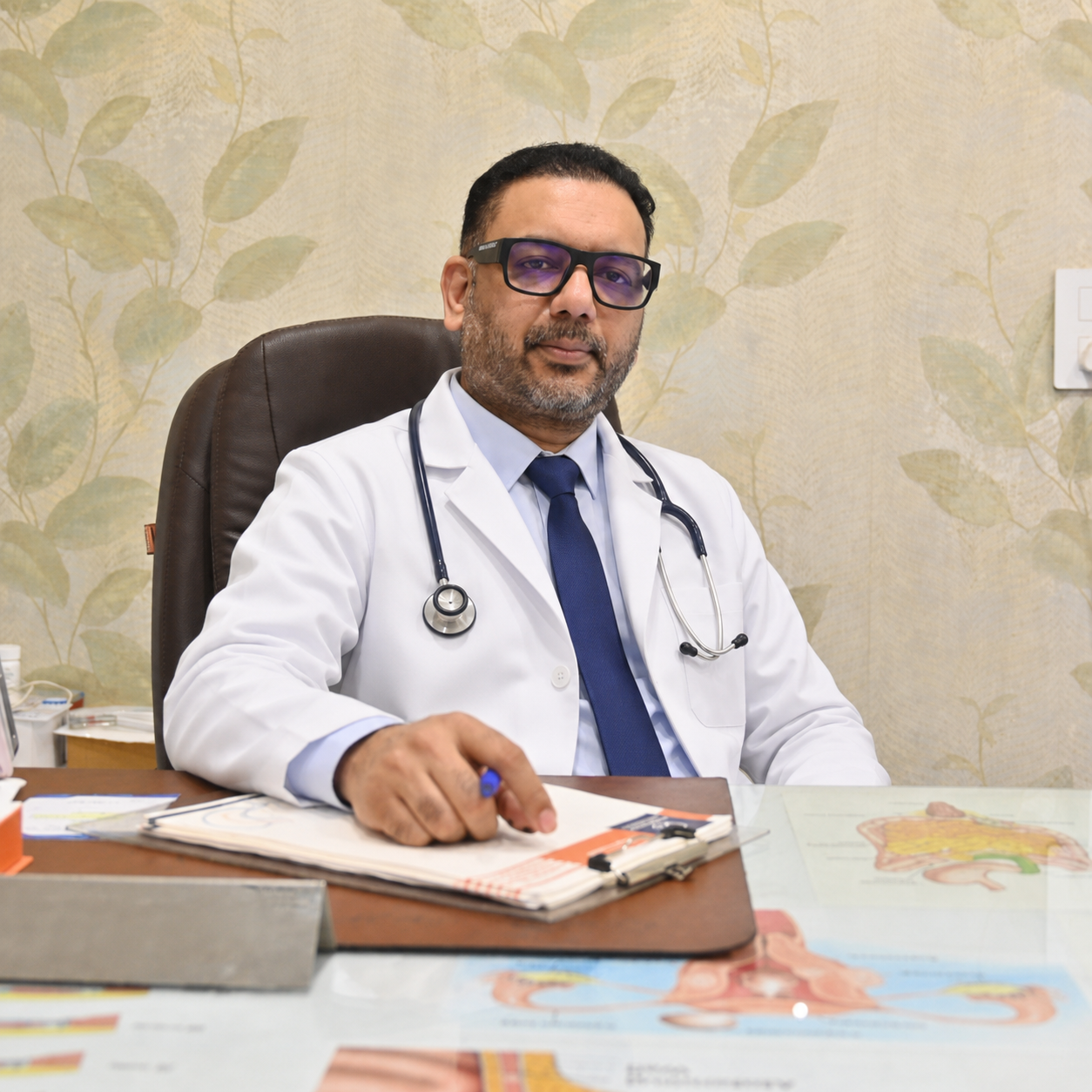
Answer box: Appendicitis is a swollen, infected appendix, a small finger-like pouch on the lower right side of your gut. It needs surgery in most cases, and early surgery is safest. Dr Raman Garg, surgical gastroenterologist at Bombay Gastro & Cancer Institute, Bathinda, Punjab, India, removes the appendix by keyhole surgery, with 24/7 emergency care support.
What is appendicitis, in plain words?
Your appendix is a small tube, about the length of a finger, attached to the large gut on the lower right side of the belly. We do not need it to live. Sometimes it gets blocked by hard stool, a small stone of stool or swelling, and germs grow inside. The appendix swells, fills with pus and can burst.
A burst appendix spreads infection through the belly. That is why appendicitis is treated as an emergency problem, and why people say "appendix ka operation jaldi karwana chahiye". Waiting at home with painkillers and hot water bags is the common mistake we see.
The right surgeon for this is a surgical gastroenterologist, a stomach and gut specialist who also operates. Learn more about laparoscopic surgery in Bathinda.
Symptoms and when to worry
The classic story goes like this:
- Dull pain around the navel that starts first (pet ke beech mein dard)
- After some hours, the pain moves to the lower right side and becomes sharper (pet ke daayein taraf dard)
- Loss of appetite, nausea and vomiting
- Low fever, often 99 to 101 degrees Fahrenheit
- Pain gets worse when you cough, walk, or press and release the right lower belly
- Constipation or loose motion, and a feeling of bloating
Not everyone follows this pattern. Children, older people, women in pregnancy and some adults feel pain in other spots. For more, read the blog on appendix pain symptoms.
Ravneet, a 19 year old college student from Giddarbaha, woke at 3 AM with pain around the navel. By noon it had moved to the lower right and he could not stand straight. He was operated by keyhole the same evening and was walking the next morning. Quick action made it simple.
Red flags: get same-day hospital care. Go to a hospital the same day, or call +91 82641-60001 right now, if you have pain in the lower right belly that keeps rising, pain with fever and repeated vomiting, a hard tight belly, pain that suddenly gets worse and then seems to ease (this can mean it has burst), or if a child, an elderly person or a pregnant woman has these signs. Do not take strong painkillers and wait, because they can hide the signs.
Causes and risk factors
The appendix gets blocked, then infected. Reasons include hard stool, swollen lymph glands after an infection, and rarely a growth. Appendicitis can happen at any age but is most common between 10 and 30 years. Low fibre food and long constipation may add to the risk. A family history of appendicitis is also noted in some patients. Many times there is no clear cause, and nothing you ate or did is to blame.
How Dr Raman Garg diagnoses appendicitis
Diagnosis begins with your story and a belly examination. Dr Raman Garg checks the tender spot and signs of irritation. He then uses a few quick tests:
- Blood tests at our in-house laboratory to look for infection
- Ultrasound of the abdomen, which shows a swollen appendix in many patients
- CT scan of the abdomen when the picture is unclear. It is arranged with trusted imaging partners in Bathinda, and reports are reviewed by Dr Raman Garg the same day.
A normal appendix is up to about 6 mm wide. A width above 6 mm with pain and tenderness points to appendicitis, but doctors look at the whole picture, not the number alone.
| Item | Starting (Rs) | Average (Rs) | Maximum (Rs) |
|---|---|---|---|
| OPD consultation | 500 | 700 | 1,000 |
| Ultrasound abdomen | 600 | 1,000 | 1,800 |
| CT scan abdomen (if needed) | 3,500 | 6,000 | 9,000 |
| Pre-operative blood tests, ECG and chest X-ray | 1,500 | 2,500 | 4,000 |
Note: These are typical Punjab costs for 2026. The final cost may vary after Dr Raman Garg examines you, depending on the number of tests needed and your health.
Similar-looking pains can come from other problems, so also see our page on stomach pain treatment in Bathinda.
Treatment options: antibiotics, surgery and what suits you
Surgery to remove the appendix, called appendectomy, is the standard treatment for appendicitis. Here is the honest picture:
- Surgery (preferred in most cases): removing the infected appendix stops the problem for good. It is advised soon after diagnosis.
- Antibiotics alone: in some mild, early cases, a short trial of antibiotics may be considered after a clear scan. The risk is that the appendicitis may come back later, and some patients still end up needing surgery. Dr Raman Garg will tell you if you are suitable.
- Waiting at home: not a treatment. A swollen appendix can burst within one to two days in some patients.
If the appendix has already burst or formed a lump or abscess, treatment is planned differently. This may include antibiotics first, draining the pus, and surgery at the right time. These cases need a surgeon's close decisions.
The procedure step by step
Most appendix operations at our hospital are done by laparoscopy, also called keyhole surgery. The steps:
- You get general anaesthesia and sleep through the operation.
- Three small cuts are made, each about the size of a button. A camera and thin instruments go in.
- The surgeon looks at the appendix and the whole belly.
- The blood supply to the appendix is secured, and the appendix is cut free.
- The appendix is removed through one of the small cuts in a bag, to keep infection away from the wound.
- The belly is washed if needed. The cuts are closed with the stitchless laparoscopic technique using skin glue.
The operation often takes 30 to 60 minutes in simple cases. If the appendix is badly infected or burst, it can take longer, and rarely the surgeon may need to change to an open cut for safety. This is a decision for your safety, not a failure.
Before and after: preparation, timeline and recovery
Preparation checklist
- Stop eating and drinking as soon as appendicitis is suspected
- Blood tests, ECG and chest X-ray, done quickly
- Tell us about allergies, past surgeries and daily medicines
- Keep your ID and insurance card ready
- A family member to stay with you
Recovery timeline
| When | What most patients can expect |
|---|---|
| Same evening | Wake up, sip water, sit up with help |
| Day 1 | Walk, eat light food, go home within 24 hours for most patients |
| Week 1 | Light home activity, soft diet, no heavy lifting |
| Weeks 2 to 3 | School, desk work and normal routine for most patients |
| Weeks 4 to 6 | Sports and heavy work, as advised at follow-up |
Timelines differ if the appendix had burst, and recovery may take longer. Dr Raman Garg follows you by phone or video. Read more on laparoscopic surgery benefits and recovery.
Is appendix surgery very painful? There is soreness at the cuts and some shoulder or belly gas pain for a day or two. Medicines keep it manageable, and most patients walk the same day.
Risks and how they are handled
Every operation has risks. For appendectomy these include wound infection, bleeding, a pus collection inside the belly, injury to nearby organs, and bowel function that is slow to restart. Risks are higher when the appendix has already burst. Anaesthesia has its own risks, which are checked before surgery.
They are lowered by operating early, giving antibiotics at the right time, washing the belly well and following up closely. Call +91 82641-60001 the same day if after surgery you have high fever, pain that is rising, a wound that turns red or leaks, or you keep vomiting.
Cost of appendicitis surgery in Bathinda
| Item | Starting (Rs) | Average (Rs) | Maximum (Rs) |
|---|---|---|---|
| Laparoscopic appendix removal (appendectomy) | 40,000 | 65,000 | 1,00,000 |
Note: These are typical Punjab costs for 2026. The final cost may vary after Dr Raman Garg examines you, depending on whether the appendix has burst or formed an abscess, the type of procedure chosen, the type of anaesthesia, your age and other illnesses, and your health.
For context, published ranges from Mohali and Chandigarh hospitals put keyhole appendix surgery at about Rs 30,000 to 1,00,000. Keyhole costs more than open surgery because of equipment, but patients go home sooner and return to work earlier. See all prices on gastro treatment cost in Bathinda.
Insurance and cashless treatment
Bombay Gastro & Cancer Institute is empanelled with almost all major insurers and TPAs for cashless treatment, including Aditya Birla Health Insurance, Niva Bupa, Digit Insurance, Care Health Insurance, Vidal Health TPA, ICICI Lombard, Raksha TPA, Future Generali, SBI General Insurance, Oriental Insurance, Liberty General Insurance, IFFCO Tokio, Cholamandalam MS, Medi Assist TPA, and almost all other major insurers and TPAs.
- Send your policy card and reports on WhatsApp to +91 82641-60001, or bring them with you in an emergency.
- Our insurance desk checks your cover and arranges pre-authorisation, which can be done on an urgent basis.
- The insurer approves the cashless request.
- Show your card and ID. Approved items are settled directly with the insurer.
In a true emergency, treatment is not delayed for paperwork. Ayushman Bharat: Call us with your card details and our insurance desk will tell you the same day how your card can be used. Read cashless insurance for gastro treatment.
Facilities at BGCI
- Modern laparoscopic operation theatre
- Advanced endoscopy and colonoscopy suite
- Fully equipped in-house diagnostic laboratory for quick blood tests
- Comfortable patient rooms
- 24/7 emergency care support on +91 82641-60001
- Cashless insurance desk
- Stitchless laparoscopic technique with skin glue
- Same-day walking and discharge within 24 hours for most keyhole surgeries
- One surgeon from consultation to follow-up
- Online pre-arrival consultation for out-of-town and NRI patients (share reports on WhatsApp)
- Follow-up by phone or video
CT scans are arranged with trusted imaging partners in Bathinda, and reports are reviewed by Dr Raman Garg the same day. See the gastro hospital in Bathinda page.
Why patients choose Dr Raman Garg
- A surgeon, not only a physician: Dr Raman Garg is a surgical gastroenterologist who decides on and performs the operation himself.
- Experience: 20+ years and 10,000+ laparoscopic surgeries.
- Training: MBBS (Government Medical College, Patiala), MS General Surgery (Dayanand Medical College & Hospital, Ludhiana), DNB Surgical Gastroenterology (Lilavati Hospital and Research Centre, Mumbai), advanced laparoscopy training in Seoul, South Korea.
- Emergency readiness: 24/7 emergency care support.
- One surgeon from consultation to follow-up.
See Dr Raman Garg for his full profile. If you want to know how to choose a doctor, read how to choose a gastro doctor in Bathinda.
Patients we see from your area
Appendix emergencies are time-sensitive, so distance matters. Drive times by road: Goniana Mandi 12 km, 20 min | Rampura Phul 30 km, 40 min | Giddarbaha 45 km, 1 hr | Mansa 50 km, 1 hr | Muktsar 55 km, 1 hr 10 min. If you are far, first go to the nearest hospital emergency room, then call BGCI on +91 82641-60001 so we can guide the next step. See areas we serve.
How to book or reach us
- Emergency (severe pain, vomiting, fever): call +91 82641-60001 now, any hour, and come directly.
- Planned review (mild or repeated pain): call or WhatsApp +91 82641-60001 or +91 99885-03800 and send any ultrasound.
- Visit OPD, Monday to Saturday, 10 AM to 5 PM. OPD consultation Rs 500 to 1,000. Sunday is emergency only.
- Tests and the plan are set the same day.
Address: Bombay Gastro & Cancer Institute, Power House Road, Near Street No. 10, Bathinda, Punjab 151001, India. Email: bgcibathinda@gmail.com. Book appointment.
Related pages
Gallbladder removal | Hernia surgery | Intestinal obstruction surgery | Gastro emergency | Gastro doctor in Bathinda | All gastro treatment
This page is general information; your plan is set after Dr Raman Garg examines you.
Medically reviewed by Dr Raman Garg. Last updated: 8 November 2026.