
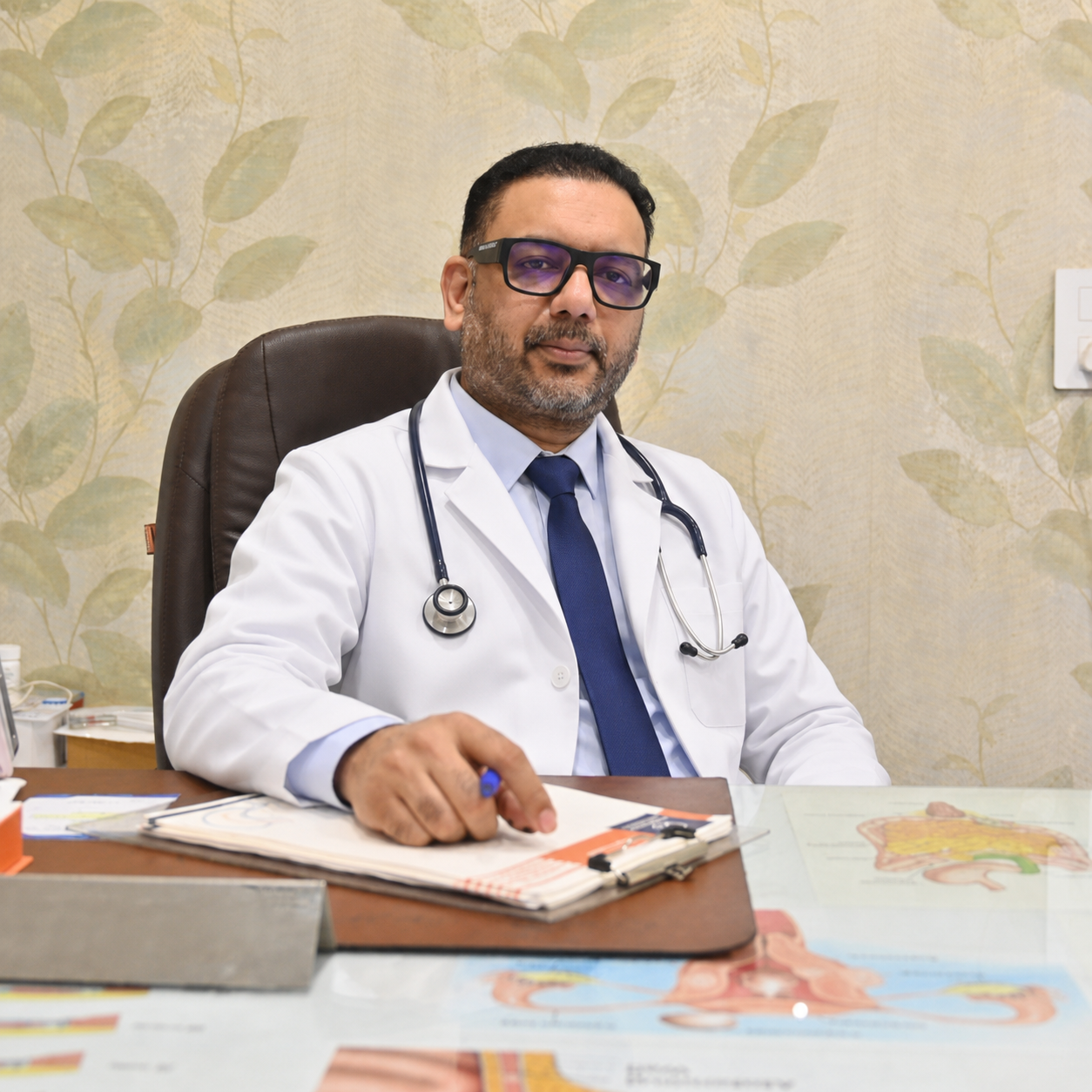
Answer box: Piles (bawasir) are swollen cushions of blood vessels at the anus. They cause bleeding, a lump or itching, and most patients improve with food, medicines and simple procedures. Surgery is kept for those who need it. Dr Raman Garg, surgical gastroenterologist at Bombay Gastro & Cancer Institute, Bathinda, Punjab, India, examines you, rules out other causes of bleeding and plans your care.
What are piles (bawasir) in plain words?
Inside the last part of your gut there are soft cushions full of blood vessels. They help you hold stool. When these cushions swell and slip down, you call it piles, bawasir or bavaseer. Doctors call them haemorrhoids.
There are two kinds. Internal piles sit inside the anus. You may not feel them, but they bleed. External piles sit under the skin outside the anus and feel like a lump, a mass or a sore spot. Internal piles are graded from 1 to 4. Grade 1 only bleeds. Grade 2 comes out while passing stool and goes back by itself. Grade 3 comes out and needs to be pushed back. Grade 4 stays out all the time.
Haemorrhoids are very common. Many people feel shy and wait for years. Please do not. Dr Raman Garg is a surgical gastroenterologist, meaning a stomach, gut, liver, gallbladder and pancreas specialist who also operates. One doctor looks at your problem, tells you if medicines are enough, and operates if needed.
Symptoms of piles and when to worry
- Bright red blood on the stool, on the paper or dripping after potty (khooni bawasir)
- A soft lump or mass at the anus that comes out while passing stool
- Itching, burning or a feeling that the bowel is not fully empty
- Mucus staining the underwear
- A hard, painful, bluish lump at the edge of the anus, which can mean a clot in an external pile
Piles bleeding is usually painless fresh blood after stool. Pain while passing stool usually points to a fissure instead. You can read the difference on our page for anal fissure treatment.
Red flags, go to a hospital the same day: heavy bleeding that fills the toilet, dizziness or fainting with bleeding, black or tarry stool, fever with severe anal pain, or a lump that is hard, very painful and cannot be pushed back. Call +91 82641-60001 on the way.
Not every bleed is piles. A 48 year old farmer from Maur Mandi who has bled for months and lost weight may have a growth in the colon, not piles. Blood in stool after age 40, a change in bowel habit lasting more than three weeks, or weight loss needs a scope test. See blood in stool treatment.
Causes and risk factors
Piles come from long pressure on the veins at the anus. The common reasons in Punjab are:
- Kabz (constipation) and hard stool, often from low fibre, little water and too much maida, fried food and white bread
- Straining or sitting a long time on the toilet, especially with a phone
- Long hours of sitting: truck and tractor drivers, shopkeepers, office staff, mandi clerks
- Heavy lifting and standing: labour, farm work, weight training
- Pregnancy and the months after delivery
- Chronic loose motions and frequent laxative use
- Family history, ageing and obesity
- A low-water, high-spice, high-tea routine, common in the cotton and wheat season when meals are irregular
How Dr Raman Garg diagnoses piles
The visit is private and unhurried. Dr Raman Garg asks about your stool habit, food, water, bleeding and pain. Then he does a short, gentle examination of the anus and, where suited, a small scope check (proctoscopy) to see internal piles.
He decides whether a colonoscopy is needed. If you are over 40, have bled for a long time, have weight loss or anaemia, or have a family history of colon problems, a colonoscopy checks the whole large bowel so nothing serious is missed. See colonoscopy in Bathinda. Blood and stool tests are done in our in-house laboratory.
| Item | Starting (Rs) | Average (Rs) | Maximum (Rs) |
|---|---|---|---|
| OPD consultation | 500 | 700 | 1,000 |
| Stool routine test | 100 | 150 | 300 |
| Colonoscopy, diagnostic | 4,500 | 7,000 | 12,000 |
| Pre-operative blood tests, ECG and chest X-ray | 1,500 | 2,500 | 4,000 |
Note: These are typical Punjab costs for 2026. The final cost may vary after Dr Raman Garg examines you, depending on the number of tests needed and your health.
Treatment options: medicines and food, procedures, or surgery
Step 1: Food, habit and medicines (grade 1 and 2, most early piles). Most patients with early piles do well without any operation. The plan is simple: 25 to 30 grams of fibre a day (dalia, oats, fruit, salad, sprouts, whole wheat roti), 8 to 10 glasses of water, a stool softener such as isabgol, and no more than 5 minutes on the toilet. Short courses of medicines and creams settle bleeding and swelling. A warm water sitz bath for 10 minutes after stool eases the burn. Many patients feel better in 1 to 3 weeks.
Step 2: Simple procedures (some grade 2 and 3). If bleeding keeps coming back, a small procedure such as rubber band ligation can be done in the clinic or the operation theatre. A band is placed on the pile so it shrinks and falls away. It suits selected patients. Dr Raman Garg tells you honestly if you are one of them.
Step 3: Surgery (grade 3 and 4, or when other steps fail). Surgery is for piles that keep coming out, bleed a lot, or come with a large external mass. The choice depends on your piles, not on a package:
- Stapler haemorrhoidopexy: a stapling device lifts the piles back up and cuts off their blood supply. Suited to circular grade 2 to 3 piles.
- Open or closed haemorrhoidectomy: the swollen tissue is removed under anaesthesia. Suited to large grade 3 to 4 and external piles.
- Ligation of the blood vessel feeding the pile in selected patients.
Surgery is NOT needed for most patients. If your piles are small, Dr Raman Garg will say so and send you home with a plan and not a bill.
The procedure step by step
- You meet Dr Raman Garg, who explains the choice and answers every question.
- Pre-operative tests are done the same day or the day before.
- You fast for 6 hours. A mild bowel-clearing medicine or enema is given.
- Anaesthesia: spinal or general, as suited to your age and health.
- The planned procedure is carried out. Most take 20 to 40 minutes.
- You rest and wake up in a comfortable room. A small dressing is placed.
- Most patients walk the same day. Pain medicines are given on a schedule so you stay comfortable.
- Most patients go home the same day or the next day with a written diet and care sheet.
Before and after: preparation, timeline and recovery
Preparation checklist
- Bring old reports, medicine list and any blood thinner details
- Tell us about diabetes, blood pressure, heart disease, allergies
- Stop blood thinners only if Dr Raman Garg says so
- Eat a light dinner. Nothing to eat for 6 hours before, nothing to drink for 2 hours before
- Shave nothing, bring loose clothes and a family member
Recovery timeline (most patients)
| When | What to expect |
|---|---|
| Day of surgery | Walking within hours. Mild to moderate soreness, controlled with medicines. |
| Day 1 to 3 | First stool can feel scary. Softener, warm sitz bath and fibre make it easy. |
| Week 1 | Light desk work and short travel for most patients. Some spotting is common. |
| Week 2 to 3 | Driving and heavy work usually resume. Wound keeps healing. |
| Week 4 to 6 | Complete healing for most patients. Follow-up by phone or video. |
A farmer or labourer who lifts bags should plan 2 to 3 weeks off heavy work. A shopkeeper who sits at the counter can often return in about a week.
Care at home: warm sitz bath 2 to 3 times a day and after each stool, high-fibre food, water, no straining, no spicy or heavy fried food for the first weeks, short walks.
Risks and how they are handled
Every operation has risks. For piles, the possible ones are pain, bleeding after surgery, difficulty passing urine for a few hours, infection, a skin tag, piles coming back, and rarely narrowing of the anus or a leak of stool or gas. Dr Raman Garg reduces these by choosing the right method for your piles, careful technique, medicines for pain and urine, and a clear diet plan. Piles can return if kabz and straining continue, so the habit changes matter as much as the surgery. Call us the same day for heavy bleeding, fever, or if you cannot pass urine.
Cost of piles treatment in Bathinda
Published ranges from Mohali and Chandigarh hospitals put piles surgery at about Rs 35,000 to 85,000. Metro hospitals often charge more. Our figures are below.
| Item | Starting (Rs) | Average (Rs) | Maximum (Rs) |
|---|---|---|---|
| OPD consultation | 500 | 700 | 1,000 |
| Piles surgery (stapler, open or ligation, as suited) | 35,000 | 55,000 | 85,000 |
Note: These are typical Punjab costs for 2026. The final cost may vary after Dr Raman Garg examines you, depending on the grade of piles, type of procedure chosen, anaesthesia type and your health.
For the full price list, see gastro treatment cost in Bathinda.
Insurance and cashless treatment
BGCI is empanelled with almost all major insurers and TPAs for cashless treatment, including Aditya Birla Health Insurance, Niva Bupa, Digit Insurance, Care Health Insurance, Vidal Health TPA, ICICI Lombard, Raksha TPA, Future Generali, SBI General Insurance, Oriental Insurance, Liberty General Insurance, IFFCO Tokio, Cholamandalam MS, Medi Assist TPA, and almost all other major insurers and TPAs.
- Send your policy card and reports on WhatsApp +91 82641-60001.
- The insurance desk checks your cover and arranges pre-authorisation.
- You get the approval and a surgery date.
- After the procedure, the desk settles the bill directly with the insurer.
Ayushman Bharat: Call us with your card details and our insurance desk will tell you the same day how your card can be used. More on cashless insurance for gastro treatment.
Facilities at BGCI
- Modern operation theatre and a clean, private examination room
- Advanced endoscopy and colonoscopy suite for scope tests
- Fully equipped in-house diagnostic laboratory
- Comfortable patient rooms
- 24/7 emergency care support on +91 82641-60001
- Cashless insurance desk
- Same-day walking and discharge within 24 hours for most patients
- One surgeon from consultation to follow-up
- Online pre-arrival consultation for out-of-town and NRI patients: share reports on WhatsApp
- Follow-up by phone or video
See the gastro hospital in Bathinda page for the full list.
Why patients choose Dr Raman Garg for piles
- A surgeon with 20+ years and 10,000+ laparoscopic surgeries, so you meet a senior gut specialist and not a junior
- MBBS (Government Medical College, Patiala), MS General Surgery (DMC&H, Ludhiana), DNB Surgical Gastroenterology (Lilavati Hospital, Mumbai). Read more about Dr Raman Garg.
- He checks the whole gut, so a bleed from a growth is not mistaken for piles
- Honest advice: medicines first, surgery only when needed
- One surgeon from first visit to follow-up
- Plain-language talk in Punjabi, Hindi or English
Patients we see from your area
Patients come to BGCI for piles care from Goniana Mandi (12 km), Rampura Phul (30 km), Maur Mandi (30 km), Mansa (50 km), Muktsar (55 km), Barnala (70 km) and more towns listed on areas we serve. Many come for a morning OPD, finish tests, and return the same day.
How to book
- Call or WhatsApp +91 82641-60001 or +91 99885-03800.
- Send a short note about your problem and any reports.
- Pick an OPD slot: Monday to Saturday, 10 AM to 5 PM.
- Visit Bombay Gastro & Cancer Institute, Power House Road, Near Street No. 10, Bathinda, Punjab 151001, India.
Emergency care support is available 24/7 on +91 82641-60001. Sunday: emergency only. Email: bgcibathinda@gmail.com. Book online at book appointment.
Related pages
Anal fissure treatment | Fistula treatment | Blood in stool treatment | Constipation treatment | Colonoscopy | Piles: operation or without operation | Piles vs fissure vs fistula | All gastro treatments
This page is general information; your plan is set after Dr Raman Garg examines you.
Medically reviewed by Dr Raman Garg | Last updated: 8 November 2026