
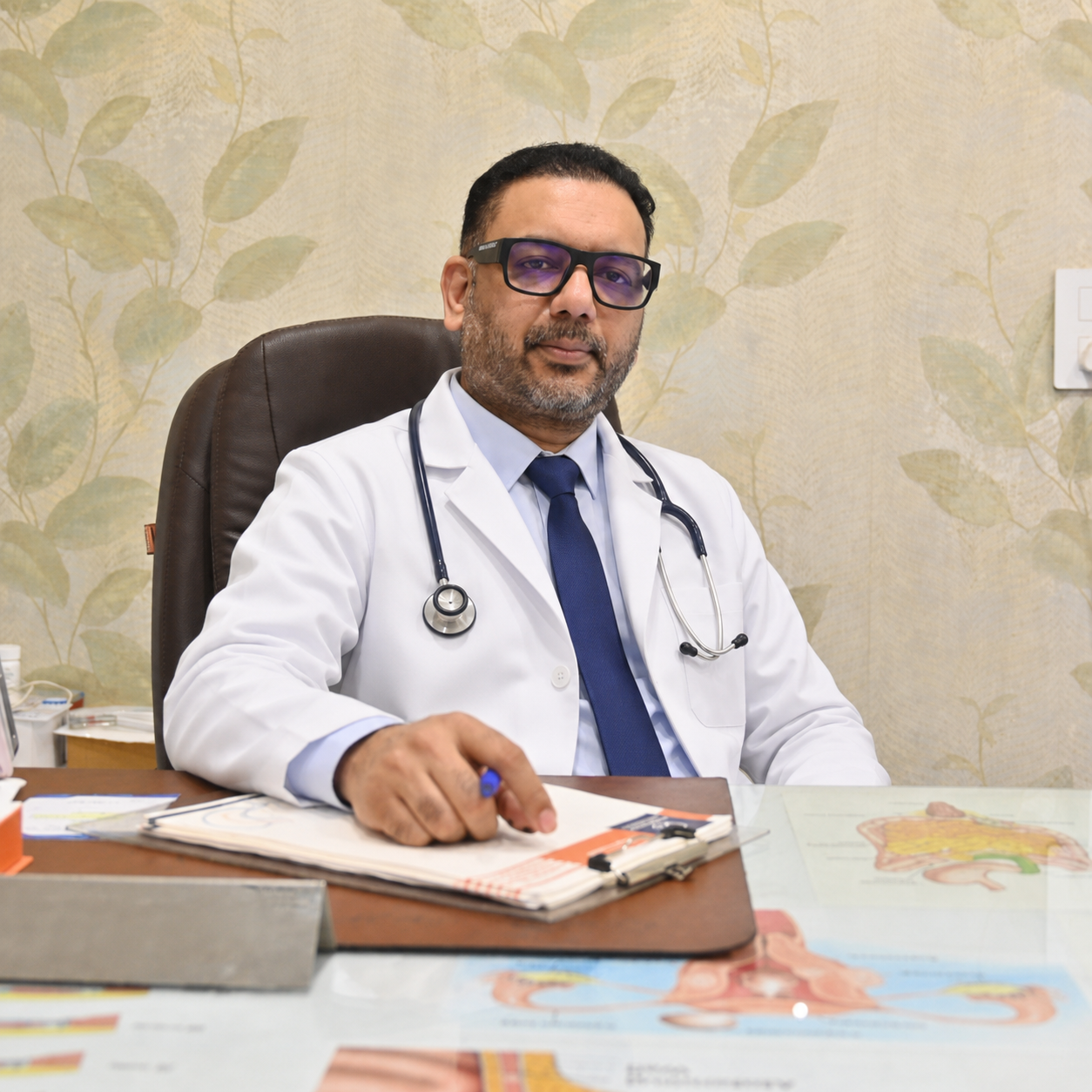
Answer box: An anal fissure is a small tear in the lining of the anus. It causes sharp pain during and after stool, often with a streak of bright red blood. Most fresh fissures heal with food, water, a stool softener and a prescribed ointment. Dr Raman Garg, surgical gastroenterologist at Bombay Gastro & Cancer Institute, Bathinda, Punjab, India, offers a short surgery only for fissures that do not heal.
What is an anal fissure (kat or chira) in plain words?
The skin just inside the anus is thin and delicate. When a hard, dry stool stretches it, the skin can split like a cracked lip. That split is an anal fissure, called kat or chira in many homes. The tear is usually at the back, in the middle line.
Here is why it hurts for so long. The muscle ring around the anus, the sphincter, goes into spasm when the tear stings. The spasm squeezes the wound, cuts its blood supply and stops healing. Then the next stool tears it again. This cycle is why a small crack can trouble a person for months.
A fissure that is less than 6 weeks old is acute. One that has lasted longer, often with a small skin tag at the edge, is chronic. The plan is different for each. Dr Raman Garg is a surgical gastroenterologist, meaning a stomach, gut, liver, gallbladder and pancreas specialist who also operates, so he can treat you with medicines or surgery as your fissure needs.
Symptoms of fissure and when to worry
- Sharp, cutting or burning pain while passing stool, lasting from a few minutes to several hours after
- A thin streak of bright red blood on the stool or tissue paper, usually not a heavy bleed
- Fear of going to the toilet, so you hold the stool and kabz gets worse
- Itching or a small tender lump (skin tag) at the anus
- A feeling of tightness or spasm after stool
Many people think this is piles. It is not the same. Piles usually bleed without much pain. A fissure hurts first and bleeds a little. See piles treatment in Bathinda and the blog on piles vs fissure vs fistula.
Red flags, go to a hospital the same day: very heavy bleeding, fever with a swollen, red, throbbing area near the anus (this can be an abscess), severe pain that stops you passing urine or stool, or black stool. Call +91 82641-60001 on the way.
A fissure on the side of the anus, not in the middle line, or one with weight loss, long diarrhoea or blood mixed in the stool needs a deeper check. It may point to another gut condition, and a colonoscopy may be advised.
Causes and risk factors
- Hard stool and kabz, the most common cause. A person who eats little fibre and drinks little water during the busy wheat harvest or long truck trips is a classic case.
- Straining, or sitting a long time on the toilet
- Repeated loose motions that irritate the skin
- Childbirth, which stretches the area
- Tight sphincter muscle that squeezes the tissue
- Long sitting jobs and low physical activity
- Gut conditions such as Crohn's disease, and some infections, in a few patients
Young adults and young mothers are affected as often as older people. A 28 year old shop assistant in Bathinda who skips water and breakfast and eats parathas for lunch is as likely to get one as a 60 year old retired teacher.
How Dr Raman Garg diagnoses a fissure
Dr Raman Garg listens first: when the pain began, how long it lasts after stool, how you pass stool, how much water and fibre you take. Often a gentle look at the anus is enough to see the crack. If the area is too painful, he does not force an examination. A soothing medicine is started and the exam is completed at the next visit.
A colonoscopy is needed only if there are warning signs: age above 40 with bleeding, blood mixed with stool, weight loss, a fissure in an unusual place, or suspected gut inflammation. See colonoscopy in Bathinda.
| Item | Starting (Rs) | Average (Rs) | Maximum (Rs) |
|---|---|---|---|
| OPD consultation | 500 | 700 | 1,000 |
| Stool routine test | 100 | 150 | 300 |
| Colonoscopy, diagnostic (only when advised) | 4,500 | 7,000 | 12,000 |
| Pre-operative blood tests, ECG and chest X-ray | 1,500 | 2,500 | 4,000 |
Note: These are typical Punjab costs for 2026. The final cost may vary after Dr Raman Garg examines you, depending on the number of tests needed and your health.
Treatment options: medicines first, surgery only for stubborn fissures
Fresh fissure (under 6 weeks): most patients heal without surgery. The plan has four parts:
- Soft stool: 25 to 30 grams of fibre a day, 8 to 10 glasses of water, isabgol at night, fruit and salad, less maida and fried food.
- Warm sitz bath: sit in warm water for 10 minutes, 2 to 3 times a day and after each stool. It relaxes the muscle.
- Prescribed ointment: a muscle-relaxing ointment such as a nitrate or calcium-channel type, applied for 6 to 8 weeks as Dr Raman Garg directs. Some patients get a headache with the nitrate type, and he will tell you what to expect.
- Short pain-relief course and a stool softener tablet if kabz is strong.
With this routine, many fresh fissures heal in 4 to 8 weeks. Healing is only lasting if stool stays soft, so the food habits matter after the ointment ends.
Chronic fissure (over 6 to 8 weeks, or keeps coming back). If the ointment course is complete and pain remains, the sphincter spasm is the problem. Two options are considered:
- Botulinum injection into the sphincter in selected patients, which relaxes the muscle for some months. It can be repeated and is not for everyone.
- Lateral internal sphincterotomy: a small cut in a small part of the inner sphincter muscle, which breaks the spasm so the crack heals. It has high success in relieving pain, and the tear heals in most patients. Dr Raman Garg explains why this is chosen, the risks, and your other options before you decide.
Surgery is NOT needed for most fresh fissures. If your first fissure is only two weeks old, give the routine a real try before thinking of an operation.
The procedure step by step (lateral sphincterotomy)
- Consultation, examination and a clear plan. You sign consent after your questions are answered.
- Pre-operative tests: blood tests, ECG and chest X-ray as needed.
- You fast for 6 hours. A mild enema may be given.
- Anaesthesia, spinal or general, chosen for your age and health.
- The sphincter muscle is released through a very small cut. The fissure and any skin tag may be cleaned or removed. Most procedures take 15 to 30 minutes.
- You rest in a comfortable room, and the dressing is checked.
- Most patients walk within hours, and most go home the same day or the next day.
- A written plan for food, sitz baths, medicines and follow-up goes home with you.
Before and after: preparation, timeline and recovery
Preparation checklist
- Carry old reports, medicine list and ointments you have used
- Mention diabetes, blood pressure, heart disease, allergies and blood thinners
- Fast for 6 hours before, with sips of water allowed until 2 hours before
- Bring a family member and loose clothing
Recovery timeline (most patients)
| When | What to expect |
|---|---|
| Day of surgery | Walking within hours. The squeezing pain of the fissure is usually much reduced. A mild wound soreness remains. |
| Day 1 to 3 | Warm sitz baths, softener and fibre. First stool is easier with the plan. Spotting is common. |
| Week 1 | Desk work and short trips for most patients. Avoid long bike rides. |
| Week 2 to 3 | Heavy work and driving for most patients. |
| Week 4 to 6 | The area is healed for most. Follow-up by phone or video. |
A shopkeeper often resumes work in 3 to 5 days. A tractor driver or labourer plans on 2 weeks.
Care after treatment: keep stool soft, do not strain, avoid long toilet time, sit in warm water after stool, and walk daily.
Risks and how they are handled
Every procedure has risks. After a sphincterotomy, risks include bleeding, infection, a wound that heals slowly, and fissure coming back. A small number of patients have trouble holding gas or a slight stain of stool for a short time, and rarely longer. Dr Raman Garg lowers the risk by selecting the right patient, cutting only the needed part of the muscle, and avoiding surgery when medicines can work. If you have heavy bleeding, fever or cannot pass urine, call us the same day.
The ointment course can cause a headache, dizziness or local irritation. Tell us if it troubles you so the plan can change.
Cost of fissure treatment in Bathinda
Most fresh fissures need only OPD visits and medicines. A surgery cost applies only if the fissure is chronic and surgery is advised.
| Item | Starting (Rs) | Average (Rs) | Maximum (Rs) |
|---|---|---|---|
| OPD consultation | 500 | 700 | 1,000 |
| Anal fissure surgery (lateral sphincterotomy) | 28,000 | 40,000 | 65,000 |
Note: These are typical Punjab costs for 2026. The final cost may vary after Dr Raman Garg examines you, depending on whether the fissure is chronic, type of procedure chosen, anaesthesia type and your health.
See all rates at gastro treatment cost in Bathinda.
Insurance and cashless treatment
BGCI is empanelled with almost all major insurers and TPAs for cashless treatment, including Aditya Birla Health Insurance, Niva Bupa, Digit Insurance, Care Health Insurance, Vidal Health TPA, ICICI Lombard, Raksha TPA, Future Generali, SBI General Insurance, Oriental Insurance, Liberty General Insurance, IFFCO Tokio, Cholamandalam MS, Medi Assist TPA, and almost all other major insurers and TPAs.
- Share your policy card and reports on WhatsApp +91 82641-60001.
- The insurance desk checks your cover and arranges pre-authorisation.
- You receive approval and a procedure date.
- After treatment, the desk settles the bill directly with the insurer.
Ayushman Bharat: Call us with your card details and our insurance desk will tell you the same day how your card can be used. Details on cashless insurance for gastro treatment.
Facilities at BGCI
- Private examination room for sensitive problems
- Modern operation theatre
- Advanced endoscopy and colonoscopy suite
- Fully equipped in-house diagnostic laboratory
- Comfortable patient rooms
- 24/7 emergency care support on +91 82641-60001
- Cashless insurance desk
- Same-day walking and discharge within 24 hours for most patients
- One surgeon from consultation to follow-up
- Online pre-arrival consultation for out-of-town and NRI patients through WhatsApp
- Follow-up by phone or video
See the gastro hospital in Bathinda page for more.
Why patients choose Dr Raman Garg for fissure care
- 20+ years of experience and 10,000+ laparoscopic surgeries, with a clear habit of trying medicines before a knife
- MBBS (Government Medical College, Patiala), MS General Surgery (DMC&H, Ludhiana), DNB Surgical Gastroenterology (Lilavati Hospital and Research Centre, Mumbai). Know more about Dr Raman Garg.
- Senior surgeon who tells you when a fissure is really something else
- Respectful, private consultation for sensitive problems
- Plain advice in Punjabi, Hindi or English, and phone follow-up so you do not travel again for small questions
Patients we see from your area
Fissure patients visit BGCI from Bhucho Mandi (20 km), Nathana (20 km), Talwandi Sabo (30 km), Giddarbaha (45 km), Kotkapura (50 km), Faridkot (65 km) and other towns on areas we serve. If you feel shy about visiting a local clinic, you can first share your story on WhatsApp.
How to book
- Call or WhatsApp +91 82641-60001 or +91 99885-03800.
- Tell us your problem in a few lines.
- Choose a slot: Monday to Saturday, 10 AM to 5 PM.
- Visit Bombay Gastro & Cancer Institute, Power House Road, Near Street No. 10, Bathinda, Punjab 151001, India.
Emergency care support is available 24/7 on +91 82641-60001. Sunday: emergency only. Email: bgcibathinda@gmail.com. Use the book appointment page.
Related pages
Piles treatment | Fistula treatment | Constipation treatment | Blood in stool treatment | Piles vs fissure vs fistula | Kabz ka ilaj | All gastro treatments
This page is general information; your plan is set after Dr Raman Garg examines you.
Medically reviewed by Dr Raman Garg | Last updated: 8 November 2026