
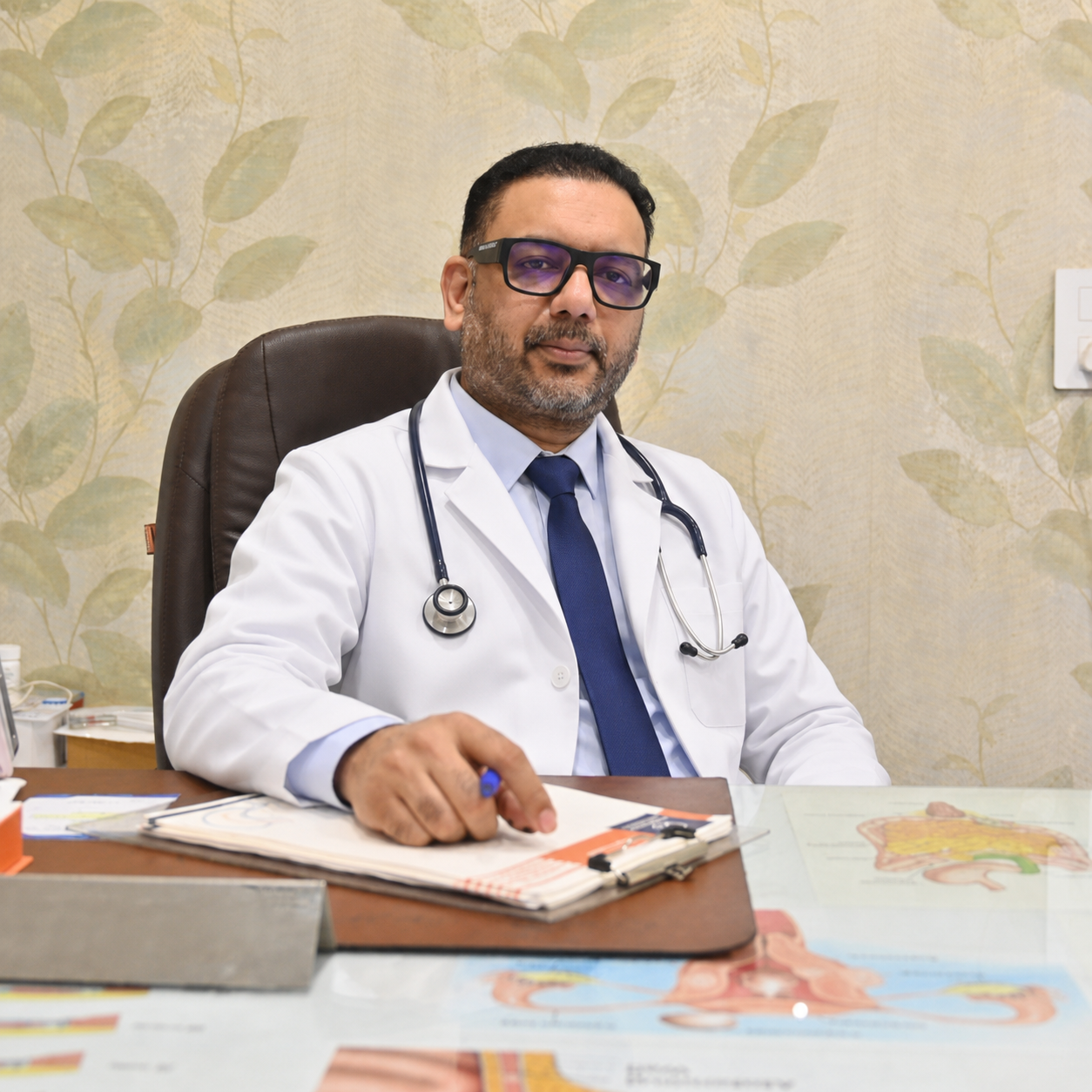
Answer box: Colonoscopy is a camera test of the large gut (colon and rectum) used to find the cause of blood in stool, long-term loose motion or kabz, and to catch polyps and early colon cancer. Dr Raman Garg, surgical gastroenterologist, does it at the endoscopy and colonoscopy suite of Bombay Gastro & Cancer Institute (BGCI), Bathinda, Punjab, India.
What is colonoscopy? (Colonoscopy kya hota hai?)
The large gut, or colon, is the last part of your digestive tube, about 1.5 metres long. It ends at the back passage (rectum and anus). Colonoscopy means passing a thin, soft, bendable tube with a light and a camera through the back passage to look at the whole lining, live on a screen. No cut is made on the body.
Why do doctors prefer it? An ultrasound or X-ray shows only shape. The camera shows the real lining: piles inside, ulcers, swelling, bleeding points, small growths (polyps) and cancers. And if Dr Raman Garg sees something, he can take a tiny piece (biopsy) or remove a small polyp in the same sitting.
A surgical gastroenterologist is a stomach, gut, liver, gallbladder and pancreas specialist who also operates. So the same doctor who does your colonoscopy can plan treatment, medicines or surgery without sending you elsewhere.
Who needs a colonoscopy? Symptoms and when to worry
Dr Raman Garg advises colonoscopy in these situations:
- Blood in stool (potty me khoon), red or dark, more than once (see blood in stool treatment)
- Change in bowel habit for more than 3 to 4 weeks: new kabz, or loose motion (dast) that keeps coming back
- Pain in the lower belly, a feeling that the stomach does not clear (pet saaf nahi hota), or thin, pencil-like stool
- Low blood count (anaemia) with no clear reason
- Weight loss with no reason
- Family history of colon cancer or polyps
- Age 45 or above, for a screening check even without symptoms
- Long-standing colitis, to check disease and look for changes (see ulcerative colitis and Crohn's treatment)
Red flags: heavy bleeding with dizziness, black tarry stool, severe belly pain with vomiting and a swollen belly, or no stool and no gas passing need same-day hospital care. Call +91 82641-60001 or go to the nearest emergency room first.
A 48 year old shopkeeper from Rampura Phul who sees blood with stool for two months and has been told it is only piles should still get examined. Piles are common, but blood can also come from a polyp or a growth, and only a proper look will tell.
What can colonoscopy find? (what is seen)
| Finding | What it means |
|---|---|
| Piles (internal) | Swollen veins at the lower end, a common cause of bright red blood. See piles treatment. |
| Fissure | A tear at the anus. See fissure treatment. |
| Polyps | Small growths on the lining. Some can turn into cancer over years, so they are removed. |
| Colitis | Redness and ulcers from inflammation (ulcerative colitis, Crohn's disease) |
| Diverticula | Small pouches in the wall, mostly harmless |
| Growth or tumour | A suspicious area is biopsied. See colon cancer surgery. |
| Normal | Many results are normal. That is good news and tells us to look at other causes, such as IBS. |
Causes and risk factors for colon problems
- Low fibre food, little water, long hours of sitting (shop, driving, office)
- Smoking, alcohol, heavy red and processed meat
- Obesity and diabetes
- Family history of colon cancer, polyps or colitis
- Age above 45
- Long-standing kabz or straining at stool
How Dr Raman Garg decides (diagnosis and tests)
First comes a talk and a belly and back-passage examination. Dr Raman Garg asks about stool colour, how long it has been going on, weight, family history and medicines. Depending on your story, you may need blood tests, a stool test, an ultrasound, or a CEA tumour marker before or after the scope. Imaging such as CT scan is arranged with trusted imaging partners in Bathinda, reports reviewed by Dr Raman Garg the same day.
| Item | Starting (Rs) | Average (Rs) | Maximum (Rs) |
|---|---|---|---|
| OPD consultation | 500 | 700 | 1,000 |
| Stool routine test | 100 | 150 | 300 |
| Ultrasound abdomen | 600 | 1,000 | 1,800 |
| Pre-operative blood tests, ECG and chest X-ray | 1,500 | 2,500 | 4,000 |
| CEA tumour marker | 500 | 650 | 1,000 |
Note: These are typical Punjab costs for 2026. The final cost may vary after Dr Raman Garg examines you, depending on the number of tests needed and your health.
Treatment options after the colonoscopy
Colonoscopy is a test, and for small polyps it is also a treatment. What comes next depends on what is seen:
- Normal result: medicines and diet for IBS, kabz or other causes. See constipation treatment.
- Piles or fissure: medicines, diet and sitting habits first. Surgery only if these fail or the problem is large.
- Small polyp: removed during the test, and sent for biopsy.
- Colitis: long-term medicines and regular follow-up.
- Cancer suspected or confirmed: biopsy, a CT scan, and then a plan. Dr Raman Garg explains stage and options in plain words. Surgery is done by him through colon cancer surgery or GI cancer surgery if needed.
Surgery is not needed in most patients who get a colonoscopy, and you are told honestly if it is not.
Bowel preparation: the most important part (Colonoscopy ki taiyari)
A clean colon gives a clear picture. If the gut is not clean, small polyps can be missed and the test may need repeating. So please follow the steps with care. Dr Raman Garg's team gives you a written sheet with timings.
| When | What to do |
|---|---|
| 7 days before | Tell us about blood thinners, diabetes medicines (insulin and tablets), iron tablets and BP medicines. Do not stop anything on your own. |
| 2 to 3 days before | Eat a low-fibre diet: plain roti or white rice, dal water, boiled potato, curd, eggs. Avoid salad, raw vegetables, fruit with seeds, whole pulses, nuts and sabut dana. |
| Day before | Clear liquids only: water, clear soup, nimbu pani, coconut water, clear juice, tea or coffee without milk. No solid food. |
| Evening before | First dose of the bowel-cleaning solution (prescribed by us), mixed in water as directed. You will pass watery stool many times. Stay near a toilet. |
| Morning of test | Second dose, about 4 to 6 hours before the test. Finish at least 2 hours before. After this, nothing by mouth except sips of water as allowed. |
| Goal | Stool becomes pale yellow and clear like urine or weak tea. If it is still brown or has bits, call us before you leave. |
Tips: Drink plenty of clear fluids during the prep. Apply a little petroleum jelly around the back passage to avoid soreness. Elderly patients and those with kidney or heart trouble should tell us, so we choose the right prep.
The procedure step by step
- Check-in and consent. Nurse checks your vitals, medicines and prep. Dr Raman Garg explains the test and you sign consent.
- Sedation. A small drip is placed in the hand and light sedation is given. You become sleepy and relaxed.
- Position. You lie on your left side with knees bent, covered with a gown and sheet.
- The scope is passed. The tube goes gently in. A little air or carbon dioxide is used to open the gut for a clear view. You may feel pressure or cramps for a moment.
- Full examination. The scope is moved to the start of the large gut. The lining is examined carefully while the tube is slowly withdrawn.
- Biopsy or polyp removal. If needed, tiny samples are taken, and small polyps are removed through the scope.
- Recovery. You rest in the recovery area until you are awake and comfortable.
Duration: the colonoscopy itself takes about 20 to 45 minutes. With check-in and recovery, plan 3 to 4 hours.
Sedation: with light sedation most patients are sleepy and remember little. Cramps or gas pressure can happen, and settle once the air passes. Tell Dr Raman Garg if you wish to try without sedation.
Before and after: day timeline and recovery
| Time | What to expect |
|---|---|
| Morning, test day | Reach with an adult. Wear loose clothes. Bring old reports, medicine list, insurance card and ID. |
| During test | 20 to 45 minutes, sleepy and monitored. |
| First hour after | Rest. Passing gas and mild cramps are common and a good sign. |
| Same day | Light food once awake, such as khichdi or dalia. No driving, no signing papers, no heavy work. |
| Next day | Most patients resume normal food and work. A little blood-tinged stool after a biopsy or polyp removal can be seen. |
Call us the same day for heavy bleeding, fever, severe belly pain, a hard swollen belly or repeated vomiting.
Results timing: after you wake up, Dr Raman Garg tells you what he saw. A printed report with pictures is given the same day. If a biopsy was taken or a polyp removed, the biopsy report usually takes about 3 to 7 days, and he explains it at follow-up in person, by phone or by video.
Biopsy and polyp removal during colonoscopy
A biopsy is a tiny piece of lining checked under a microscope. Dr Raman Garg takes it from ulcers, odd patches and growths, and also in some cases of long-term loose motion. Polyps are small growths. Removing them during the test is the common way to stop them turning into cancer later. Not every polyp is cancer, and most small polyps are not. Larger or complex growths may need a separate plan.
Risks and how they are handled
Colonoscopy is a widely used and generally safe test, but it is not risk-free.
- Bloating and cramps for some hours
- Reaction to sedation or the prep fluid, which is why we check your heart, kidney and medicines first and monitor oxygen and pulse through the test
- Bleeding after a biopsy or polyp removal, usually small
- A tear in the gut wall, which is rare and needs prompt care
- An incomplete test if the prep is poor or the gut is very twisted, in which case a repeat or another test is advised
The team watches you through the test and afterwards. You are told the warning signs before you go home.
Colonoscopy cost in Bathinda (Colonoscopy kitne ka hota hai?)
| Item | Starting (Rs) | Average (Rs) | Maximum (Rs) |
|---|---|---|---|
| Colonoscopy, diagnostic | 4,500 | 7,000 | 12,000 |
| Colonoscopy with biopsy or polyp removal | 7,000 | 10,000 | 18,000 |
| Biopsy report (histopathology), per sample | 800 | 1,500 | 3,000 |
| OPD consultation | 500 | 700 | 1,000 |
OPD consultation Rs 500 to 1,000.
Note: These are typical Punjab costs for 2026. The final cost may vary after Dr Raman Garg examines you, depending on biopsy or polyp removal done during the test, anaesthesia type and the number of tests needed and your health.
For comparison, published ranges from Mohali and Chandigarh hospitals put colonoscopy at about Rs 4,000 to 10,000. Metro hospitals often charge more. You can see our full price list at gastro treatment cost in Bathinda, and read colonoscopy cost in Punjab.
Insurance and cashless
BGCI is empanelled with almost all major insurers and TPAs for cashless treatment, including Aditya Birla Health Insurance, Niva Bupa, Digit Insurance, Care Health Insurance, Vidal Health TPA, ICICI Lombard, Raksha TPA, Future Generali, SBI General Insurance, Oriental Insurance, Liberty General Insurance, IFFCO Tokio, Cholamandalam MS, Medi Assist TPA, and almost all other major insurers and TPAs. Whether a colonoscopy is covered depends on your policy, so ask our desk before you book.
- Send your policy card and the doctor's advice on WhatsApp.
- Our insurance desk checks cover and arranges pre-authorisation.
- You receive the approval status before your visit.
- On the day, show your card and ID. The desk handles the paperwork.
Ayushman Bharat: Call us with your card details and our insurance desk will tell you the same day how your card can be used. See cashless insurance for gastro treatment.
Facilities at BGCI
- Advanced endoscopy and colonoscopy suite with high-definition screen and picture recording
- Fully equipped in-house diagnostic laboratory
- Modern laparoscopic operation theatre, in case a finding needs surgery
- Comfortable patient rooms and a monitored recovery area after sedation
- 24/7 emergency care support
- Cashless insurance desk
- CT scan and other imaging arranged with trusted imaging partners in Bathinda, reports reviewed by Dr Raman Garg the same day
- Online pre-arrival consultation for out-of-town and NRI patients: share reports on WhatsApp
- Follow-up by phone or video
See the gastro hospital in Bathinda page.
Why patients choose Dr Raman Garg
Dr Raman Garg is a surgical gastroenterologist and laparoscopic surgeon with 20+ years of experience and 10,000+ laparoscopic surgeries. He holds an MBBS from Government Medical College, Patiala, an MS in General Surgery from Dayanand Medical College & Hospital, Ludhiana, and a DNB in Surgical Gastroenterology from Lilavati Hospital and Research Centre, Mumbai, with advanced laparoscopy training in Seoul, South Korea. He is the first surgical gastroenterologist in the Malwa belt of Punjab. Because he also operates, a finding on your scope is not passed along to someone else. Read about Dr Raman Garg and the gastro doctor in Bathinda.
Patients we see from your area
Patients come for colonoscopy from Goniana Mandi (12 km, 20 min), Rampura Phul (30 km, 40 min), Mansa (50 km, 1 hr), Maur Mandi, Talwandi Sabo, Giddarbaha, Muktsar, Malout, Faridkot and Barnala. Because the prep is done at home, the best plan for out-of-town patients is to do the prep in Bathinda or at a relative's place the night before, so you are never far from a toilet on the road. See areas we serve.
How to book
- Call or WhatsApp +91 82641-60001 (or +91 99885-03800).
- Tell us your symptoms and send old reports on WhatsApp.
- Choose a date. OPD is Monday to Saturday, 10 AM to 5 PM. Sunday is emergency only.
- Collect the written prep sheet and bowel-cleaning solution.
- Come to Bombay Gastro & Cancer Institute, Power House Road, Near Street No. 10, Bathinda, Punjab 151001.
Emergency care support is available 24/7 on +91 82641-60001. Email: bgcibathinda@gmail.com.
Related pages
Endoscopy in Bathinda | Piles treatment | Blood in stool treatment | Colon cancer surgery | Blog: Colonoscopy: who needs it and prep | Early signs of colon cancer | Gastro treatment in Bathinda | Book appointment
This page is general information; your plan is set after Dr Raman Garg examines you.
Medically reviewed by Dr Raman Garg | Last updated: 8 November 2026