
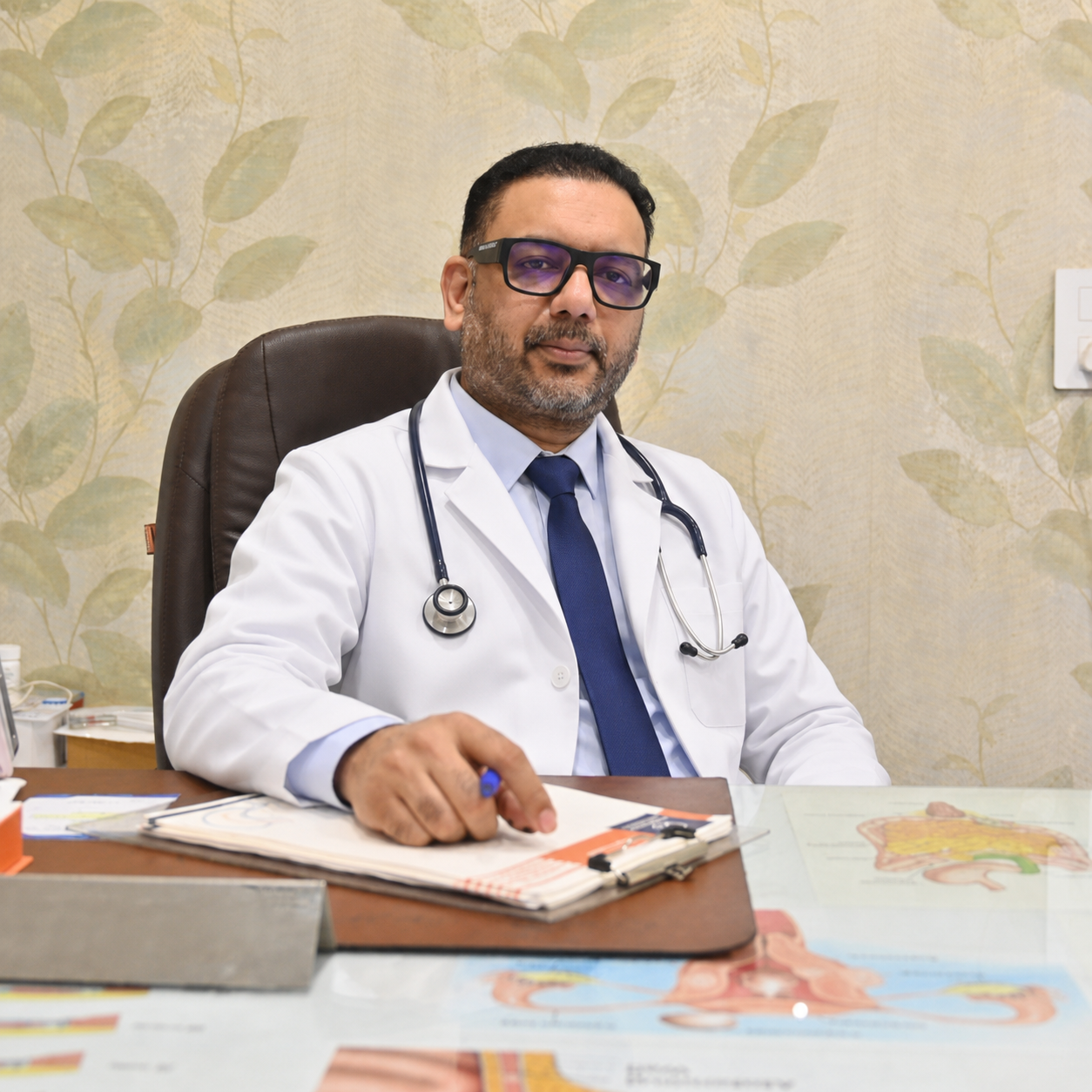
Answer box: Gall stone treatment in Bathinda depends on whether the stones cause trouble. Stones with no symptoms are usually watched. Stones that cause pain, infection or pancreas inflammation are treated by removing the gallbladder with keyhole surgery. Dr Raman Garg, surgical gastroenterologist at Bombay Gastro & Cancer Institute, Bathinda, Punjab, India, plans this for you.
What are gallstones (pite di pathri) in plain words?
The gallbladder is a small pouch under your liver, on the right side of the upper belly. It stores bile, a green fluid that helps you digest oily food. When bile turns thick or carries too much cholesterol, tiny crystals form and slowly grow into stones. This is what people call pitte ki pathri, pite di pathri or gall stone. Some stones are the size of a sand grain. Others grow as large as a lemon seed or bigger. You can have one stone or fifty.
Many people carry stones for years and never know. The trouble starts when a stone blocks the exit of the gallbladder or slips into the bile pipe. Then you get pain, vomiting, fever or yellow eyes.
Symptoms of gallstones and when to worry
The classic sign is pain in the upper right belly or just below the breastbone. It often comes 30 minutes to 2 hours after a heavy or fried meal, lasts from 30 minutes to a few hours, and may travel to the right shoulder or back. Doctors call this a gallbladder attack. Other signs are:
- Gas, bloating and a heavy feeling after meals (pet me gas, pet fulna)
- Nausea and vomiting (ulti)
- Burning in the chest that does not settle with antacids
- Pain that wakes you at night
A 45 year old shopkeeper from Rampura Phul often says, I took gas tablets for a year and the pain kept returning. Pain after fatty food that keeps coming back is a reason to get an ultrasound, not another tablet.
Red flags: get hospital care the same day if you have:
- Severe belly pain lasting more than 5 hours
- Fever with chills along with pain
- Yellow eyes or skin, dark urine or pale stool (jaundice, peeliya)
- Repeated vomiting and you cannot keep water down
- Severe pain going to the back, which can mean pancreas inflammation
Call +91 82641-60001 and our emergency care support will guide you, 24/7.
Causes and risk factors
Stones form more easily in some people. The common reasons:
- Being a woman, especially after pregnancy or while on hormone pills
- Age above 40
- Weight gain, or losing weight very fast
- A family history of gallstones
- A diet rich in fried food, ghee-heavy gravies and sweets, with little fibre
- Diabetes, fatty liver and high cholesterol
- Long gaps without eating
Farming and mandi families in the Malwa belt often eat heavy, late meals after a long work day. This does not cause stones on its own, but combined with weight gain and sitting hours, it raises the risk.
How Dr Raman Garg diagnoses gallstones
The first visit starts with your story: where the pain sits, what you ate, how long it lasts. Then a belly examination. Most cases are confirmed with one simple test.
- Ultrasound abdomen shows stones, wall thickness of the gallbladder and the width of the bile pipe. Most patients get this done on the same day.
- Blood tests including liver function test (LFT) check for infection and bile pipe blockage. These run in our in-house laboratory.
- Upper GI endoscopy is advised when acidity or ulcer may be the real cause of your pain.
- MRCP (a scan of the bile pipes) or CT scan is advised only when a stone in the bile duct or a pancreas problem is suspected. These are arranged with trusted imaging partners in Bathinda, and reports are reviewed by Dr Raman Garg the same day.
- HIDA scan checks how well the gallbladder works, used only in selected cases.
| Test | Starting (Rs) | Average (Rs) | Maximum (Rs) |
|---|---|---|---|
| OPD consultation | 500 | 700 | 1,000 |
| Ultrasound abdomen | 600 | 1,000 | 1,800 |
| Liver function test (LFT) | 400 | 600 | 1,200 |
| Upper GI endoscopy | 2,000 | 3,200 | 5,000 |
| MRCP (bile duct scan) | 4,000 | 7,000 | 12,000 |
| HIDA scan | 5,000 | 6,500 | 9,000 |
Note: These are typical Punjab costs for 2026. The final cost may vary after Dr Raman Garg examines you, depending on the number of tests needed and your health.
Gall stone treatment options: medicines, diet or surgery?
This is the part where honest advice matters. Not every stone needs an operation.
When surgery is not needed
If an ultrasound finds stones by chance and you have never had pain, most patients can simply be watched with a healthy diet and yearly review. Taking out a healthy, quiet gallbladder gives no benefit.
Gallstones without surgery: can tablets dissolve them?
This is the most common question we hear: pite di pathri ka ilaj bina operation. Bile acid tablets can dissolve only small, soft cholesterol stones, and the course lasts 6 to 24 months. Even then, stones often return after the tablets stop. Home remedies, herbal drinks and olive oil flushes do not remove stones, and some delay care until an attack turns serious. Read more in can gallstones dissolve without surgery.
When surgery is the right answer
Once a stone has caused pain, the gallbladder is the factory that makes new stones. Medicines calm the pain but do not change that. Surgery is advised when you have:
- Repeated gallbladder pain or attacks
- Infection of the gallbladder (cholecystitis) or a collapsed, thick-walled gallbladder
- A stone that slipped into the bile pipe, or earlier pancreas inflammation caused by a stone (pancreatitis treatment)
- Large stones (over 2 to 3 cm), a calcified gallbladder or a polyp
- Diabetes with stones, as infections are more severe
The operation is laparoscopic cholecystectomy: keyhole removal of the gallbladder. You can live a normal life without it. Bile simply flows straight from the liver to the gut. Full details are on our gallbladder removal surgery in Bathinda page.
The keyhole procedure step by step
- You come on the morning of surgery after fasting for 6 to 8 hours.
- Anaesthesia is given, so you sleep through it.
- Three or four small cuts, each about 5 to 10 mm, are made on the belly. A camera and thin instruments go in.
- The gallbladder is separated carefully from its artery and duct, which are clipped and cut.
- The gallbladder is placed in a bag and taken out through one cut.
- The cuts are closed with the stitchless technique using skin glue.
A planned surgery usually takes 30 to 60 minutes. Dr Raman Garg has done over 10,000 laparoscopic surgeries, and the same surgeon sees you from first visit to follow-up.
Before and after: preparation, day plan and recovery
Preparation checklist
- Pre-operative blood tests, ECG and chest X-ray
- Tell us about every tablet you take, especially blood thinners and diabetes medicines
- Stop smoking at least a week before
- Do not eat or drink after midnight on the night before
- Bring your ultrasound film and old reports
Day timeline
| When | What happens |
|---|---|
| Morning of surgery | Check-in, final review, anaesthesia |
| Same day, a few hours after | You sit up, sip water, and walk with help |
| Next morning | Review, light food, most patients go home within 24 hours |
| Day 7 to 10 | Review by phone, video or in person |
| 2 weeks | Desk work and light chores for most patients |
| 4 to 6 weeks | Heavy lifting and farm work, as Dr Raman Garg advises |
Timelines vary, and most patients follow this pattern. After surgery, eat small, low-fat meals for the first weeks, then return to a normal balanced diet. Our guide on gallstone diet: what to eat and avoid helps.
Risks and how they are handled
Every surgery carries some risk, and you should hear it plainly. Possible problems include bleeding, infection at a cut, bile leak, injury to the bile pipe, and a stone left in the bile duct. Some patients have loose motions for a few weeks. Rarely the surgeon must change from keyhole to open surgery for safety, especially when the gallbladder is badly infected. We reduce risk by operating at the right time, checking the bile pipe anatomy carefully, and fixing the problem early if one appears. Diabetes, heart disease and old age are checked before surgery.
Gall stone treatment cost in Bathinda, Punjab
| Treatment | Starting (Rs) | Average (Rs) | Maximum (Rs) |
|---|---|---|---|
| Laparoscopic gallbladder removal, planned | 40,000 | 65,000 | 1,00,000 |
| Laparoscopic gallbladder removal, difficult or after an attack | 60,000 | 90,000 | 1,40,000 |
| Pre-operative blood tests, ECG and chest X-ray | 1,500 | 2,500 | 4,000 |
Note: These are typical Punjab costs for 2026. The final cost may vary after Dr Raman Garg examines you, depending on gallstone size and number, whether there was an infection or attack, a stone in the bile duct, and your health.
For comparison, published ranges from Mohali and Chandigarh hospitals put gallbladder keyhole surgery at about Rs 40,000 to 90,000, higher for emergency cases. Keyhole costs more than open surgery because of the equipment, but patients go home sooner and return to work earlier. See the full gastro treatment cost in Bathinda list.
Insurance and cashless treatment
Bombay Gastro & Cancer Institute is empanelled with almost all major insurers and TPAs for cashless treatment, including Aditya Birla Health Insurance, Niva Bupa, Digit Insurance, Care Health Insurance, Vidal Health TPA, ICICI Lombard, Raksha TPA, Future Generali, SBI General Insurance, Oriental Insurance, Liberty General Insurance, IFFCO Tokio, Cholamandalam MS, Medi Assist TPA, and almost all other major insurers and TPAs. For Ayushman Bharat: call us with your card details and our insurance desk will tell you the same day how your card can be used.
- Send your policy card and reports on WhatsApp to +91 82641-60001.
- Our insurance desk checks your cover and arranges pre-authorisation.
- You get the approval and a date for surgery.
- After surgery, the hospital settles the bill with your insurer, and you pay only what the policy does not cover.
More on the cashless insurance for gastro treatment page.
Facilities at BGCI
- Modern laparoscopic operation theatre
- Advanced endoscopy and colonoscopy suite
- Fully equipped in-house diagnostic laboratory
- Comfortable patient rooms
- 24/7 emergency care support
- Cashless insurance desk
- Stitchless laparoscopic technique with skin glue
- Same-day walking and discharge within 24 hours for most keyhole surgeries
- One surgeon from consultation to follow-up
- Online pre-arrival consultation for out-of-town and NRI patients, by sharing reports on WhatsApp
- Follow-up by phone or video
CT, MRCP and HIDA scans are arranged with trusted imaging partners in Bathinda, and reports are reviewed by Dr Raman Garg the same day. See more about our gastro hospital in Bathinda.
Why patients choose Dr Raman Garg
Dr Raman Garg is a surgical gastroenterologist: a stomach, gut, liver, gallbladder and pancreas specialist who also operates. So one doctor decides if you need medicines, a scope test or surgery, and does it. He has MS General Surgery, DNB Surgical Gastroenterology from Lilavati Hospital, Mumbai, advanced laparoscopy training in Seoul, South Korea, and is the first surgical gastroenterologist in the Malwa belt of Punjab. Read his full profile on Dr Raman Garg.
Patients we see from your area
Gallstone patients reach us from across Punjab, India, and the Sirsa side of Haryana. Typical drives: Goniana Mandi 12 km (20 min), Rampura Phul 30 km (40 min), Mansa 50 km (1 hr), Muktsar 55 km (1 hr 10 min), Barnala 70 km (1 hr 30 min). See all areas we serve.
How to book
- Call or WhatsApp +91 82641-60001 or +91 99885-03800.
- Share your ultrasound and reports on WhatsApp if you have them.
- Visit OPD, Monday to Saturday, 10 AM to 5 PM. Sunday is emergency only.
- Get your plan the same day. Use book appointment.
Address: Bombay Gastro & Cancer Institute, Power House Road, Near Street No. 10, Bathinda, Punjab 151001, India. Email: bgcibathinda@gmail.com. Emergency care support 24/7 on +91 82641-60001.
Related pages
Gallbladder removal surgery | Laparoscopic surgery | Pancreatitis treatment | Jaundice treatment | Gastro treatment in Bathinda | Gastro doctor in Bathinda | Blogs: gallstone symptoms and causes, pite di pathri da ilaj (Punjabi)
This page is general information; your plan is set after Dr Raman Garg examines you.
Medically reviewed by Dr Raman Garg. Last updated: 8 November 2026.