
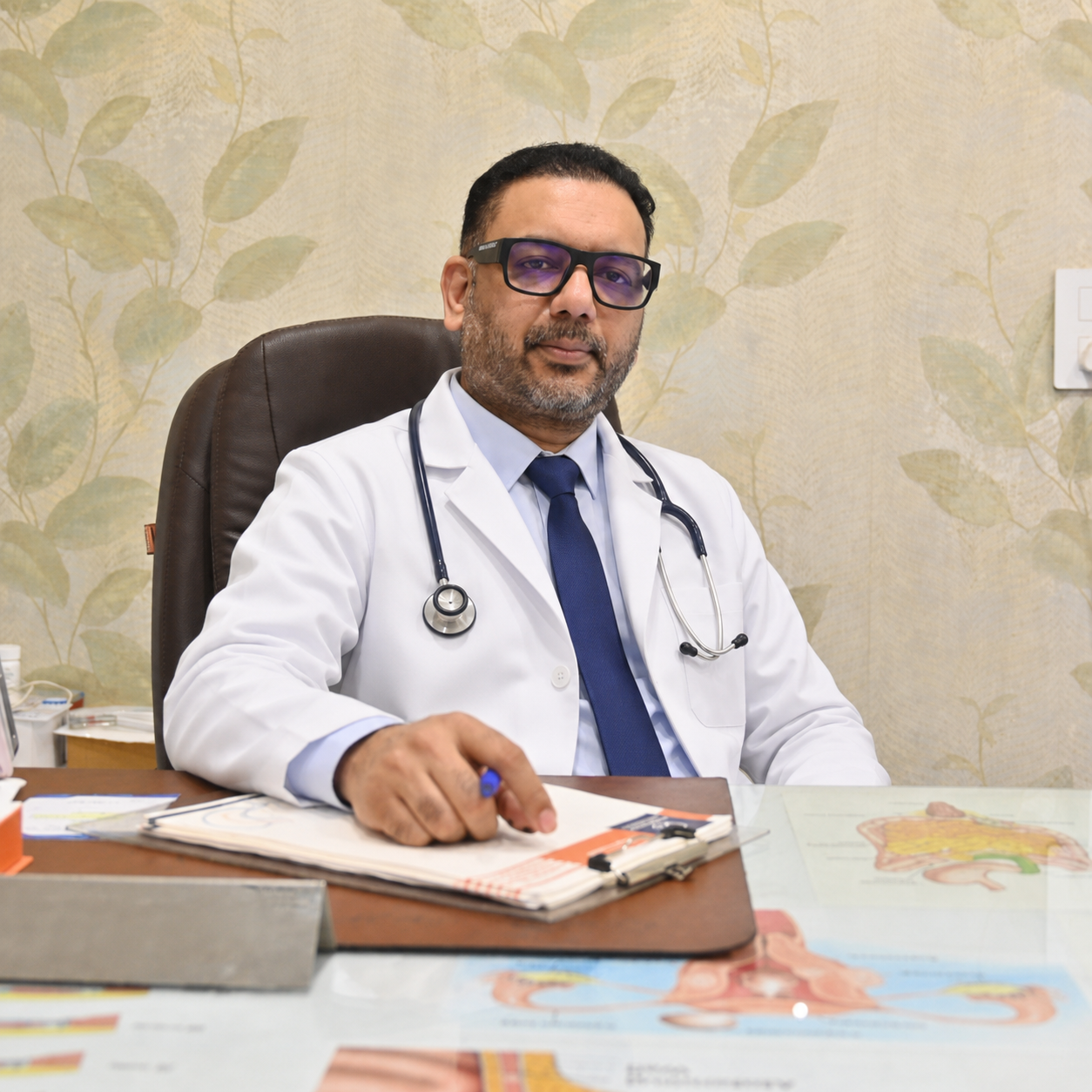
Answer box: Gas, acidity and bloating usually come from what you eat, how you eat and how your stomach and gut move. Dr Raman Garg, a leading surgical gastroenterologist at Bombay Gastro & Cancer Institute, Bathinda, Punjab, India, finds the real cause, treats it and tells you honestly when a scope test or surgery is needed.
What are gas, acidity and bloating? (Pet mein gas kya hai?)
Gas is air that collects in your stomach or gut. You swallow some with food and water. Gut bacteria make the rest when they break down food. It leaves as a burp or as wind from below. That is normal. Trouble starts when it stays trapped and gives pain, a tight tummy or loud rumbling.
Acidity is stomach acid moving where it should not. Your stomach makes acid to digest food. If that acid rises into the food pipe, you feel burning behind the chest (seene mein jalan) or a sour taste in the mouth (khatti dakar). Doctors call the long-term form acid reflux or GERD. You can read more on our acid reflux and GERD treatment page.
Bloating is the feeling that your belly is full, tight or swollen, even after a small meal. Many people say "pet fulna". Sometimes the belly really swells. Sometimes it only feels that way.
These three problems often come together, so people lump them as "gas ki problem". But the cause can be a simple habit, a stomach infection, a sluggish gut, a food intolerance or, rarely, a serious disease. That is why a proper check matters more than another round of antacid tablets.
A surgical gastroenterologist is a stomach, gut, liver, gallbladder and pancreas specialist who also operates. So one doctor can decide whether you need medicines, a scope test or surgery, and carry it out.
Symptoms and when to worry (Gas aur acidity kab khatarnak hoti hai?)
Common symptoms:
- Burning in the chest or upper belly, worse after meals or when lying down
- Sour or bitter water coming up into the mouth
- Belly feels tight, full or swollen (pet fulna)
- Frequent burping, or passing wind many times a day
- Early fullness: you feel stuffed after a few bites
- Nausea, mild vomiting or a bad taste in the morning
- Rumbling, cramps and a feeling that the stomach has not cleared (pet saaf nahi hota)
Most people with these symptoms do not have a dangerous disease. But some signs mean the problem is not simple gas. Get checked soon if you have any of these:
- Acidity or gas that lasts more than 2 to 3 weeks despite medicines
- Needing antacid tablets almost every day for months
- Weight loss without trying
- Food sticking in the throat or pain on swallowing (nigalne me dikkat)
- Repeated vomiting
- Black, tarry stools or blood in stool
- Anaemia (low haemoglobin) with no clear reason
- Symptoms starting for the first time after age 45 to 50
- A family member who had stomach or food pipe cancer
Red flags, same-day hospital care: Go to a hospital the same day if you have vomiting blood, black stools with dizziness, severe pain that does not ease, a hard swollen belly with vomiting, or chest pain with sweating and breathlessness. Chest pain can be a heart problem, not gas. Do not wait at home. Call +91 82641-60001 for emergency support, 24/7.
Causes and risk factors
A 45 year old shopkeeper from Rampura Phul eats a heavy lunch at 3 PM, has two cups of sweet tea, then sits at the counter until night. By 9 PM he has gas and burning. His story is common here. The usual causes in Punjab and the Malwa belt are:
- Meal habits: Late dinners, skipping breakfast, very large meals, eating fast, lying down right after food
- Food and drink: Fried food, heavy ghee, pickles, too much tea, cold drinks, spicy gravies, large servings of rajma, chole and other pulses that make gas
- Tobacco, alcohol and painkillers: Smoking, alcohol and regular painkiller tablets for joint or back pain irritate the stomach lining
- H pylori infection: A germ that lives in the stomach and causes burning, bloating and ulcers. See H pylori treatment
- Stomach ulcer or gastritis: Sores or inflammation in the lining. See stomach ulcer treatment
- Hiatal hernia: Part of the stomach slips above the diaphragm and pushes acid up. See hiatal hernia treatment
- Gallstones: Pain and bloating after fatty meals can come from the gallbladder, not the stomach. See gallstone treatment
- Lactose or food intolerance: Milk, lassi or wheat may not suit some adults
- Slow or irritable gut: IBS (irritable bowel syndrome) and constipation trap gas. See IBS treatment
- Stress and poor sleep: Farmers worried about a crop, shopkeepers about credit, students before exams. The gut reacts to worry
- Weight gain and pregnancy: Extra belly pressure pushes acid up
How Dr Raman Garg diagnoses it
The first visit is a conversation and an examination. Dr Raman Garg asks when the symptom comes, what you eat, what medicines you take and whether you have any warning sign from the list above. He then presses the belly, checks for tenderness, a lump or an enlarged liver, and decides which test, if any, you really need. Not everyone needs every test.
Tests that may be advised:
- Ultrasound abdomen: Checks gallbladder, liver, pancreas and kidneys. Gallstones often hide behind a "gas" complaint.
- Upper GI endoscopy (gastroscopy, dooRbeen test): A thin flexible tube with a camera goes through the mouth to look at the food pipe, stomach and first part of the intestine. It finds inflammation, ulcers, hiatal hernia and early growths. A biopsy (tiny tissue sample) can be taken at the same time. See endoscopy in Bathinda.
- H pylori stool antigen test: A simple stool test done in our in-house laboratory.
- Stool routine test and LFT (liver function test): In-house laboratory.
- Barium swallow: An X-ray test when swallowing is difficult.
- GERD pH study and manometry: Only for long-standing reflux when surgery is being considered. These are arranged with trusted imaging partners in Bathinda; Dr Raman Garg reviews the report the same day.
| Test | Starting (Rs) | Average (Rs) | Maximum (Rs) |
|---|---|---|---|
| OPD consultation | 500 | 700 | 1,000 |
| Ultrasound abdomen | 600 | 1,000 | 1,800 |
| Upper GI endoscopy (gastroscopy) | 2,000 | 3,200 | 5,000 |
| H pylori stool antigen test | 1,000 | 1,600 | 2,000 |
| Stool routine test | 100 | 150 | 300 |
| Liver function test (LFT) | 400 | 600 | 1,200 |
| Barium swallow | 1,200 | 2,000 | 3,500 |
| GERD pH study | 3,000 | 5,000 | 8,000 |
| GERD manometry | 4,000 | 7,000 | 12,000 |
Note: These are typical Punjab costs for 2026. The final cost may vary after Dr Raman Garg examines you, depending on the number of tests needed, whether a biopsy is taken during the scope and your health.
Treatment options: medicines, habits or surgery
Most gas, acidity and bloating settle without an operation. The plan depends on the cause.
1. Habit and diet changes (first for everyone). These work better than most people expect:
- Eat 3 regular meals and 1 or 2 small snacks. Do not skip breakfast.
- Finish dinner at least 2 to 3 hours before sleep.
- Chew slowly. Do not gulp water or talk while eating.
- Cut down fried food, extra ghee, pickles, cold drinks and strong tea.
- Raise the head end of the bed by 6 inches if night burning is a problem.
- Walk for 10 to 15 minutes after meals.
- Stop smoking and alcohol. Do not take painkiller tablets without asking your doctor.
- Lose a little weight if your belly is large. Even 3 to 5 kg helps.
2. Medicines. Dr Raman Garg may prescribe an acid-reducing medicine for a set period, a medicine to help the stomach empty, or a short course for gas. If H pylori is found, a 14 day combination of antibiotics and acid medicine is given. He explains each medicine, how long to take it and when to stop. Taking a stomach tablet for years on your own, without a diagnosis, is not a good plan.
3. Treating the real cause. If the scope shows an ulcer, it is treated. If the ultrasound shows gallstones, you get a plan for the gallbladder. If constipation is trapping the gas, the bowel is treated. See constipation treatment.
4. Surgery, only when needed. A small group of patients have severe reflux from a hiatal hernia, with symptoms that continue despite proper medicines and proven by tests. For them, keyhole fundoplication (wrapping the top of the stomach around the lower food pipe to make a better valve) can help. Surgery is not for ordinary gas or acidity. If you are told you need it, you will see the scope and test results first. Costs are on the cost page.
Before and after: what to expect
Before your scope (if advised):
- No food for 6 to 8 hours and no water for 2 hours before the test, unless told otherwise
- Tell us about blood thinners, diabetes tablets and allergies
- Bring old reports and your medicine strips
- Come with an adult who can take you home if you take sedation
Day timeline for most patients:
| Time | What happens |
|---|---|
| Morning | Arrive at BGCI, registration, short check-up |
| Next 20 to 30 minutes | Scope test; sedation if advised |
| After the test | Rest and tea or light food as advised |
| Same day | Dr Raman Garg explains what he saw and starts the plan |
| A few days later | Biopsy and test reports, if taken, reviewed |
| 2 to 4 weeks | Follow-up by phone, video or OPD |
Recovery pattern:
| Stage | What most patients notice |
|---|---|
| First 1 to 2 weeks of a new plan | Burning and gas start to ease |
| 4 to 8 weeks | Steady relief if habits are also fixed |
| Long term | Medicines reduced or stopped in many patients, as advised |
Risks and how they are handled
Habit changes and medicines are safe when taken as advised. Long-term acid tablets can sometimes cause side effects, which is why Dr Raman Garg gives the lowest dose for the shortest useful time. A scope test is short and safe in experienced hands. A mild sore throat or bloating for a few hours afterwards is common. Rare risks such as bleeding or a tear are explained before the test, and the team is trained to manage them. If surgery is ever needed, risks are discussed in detail first.
Cost of gas, acidity and bloating care in Bathinda
For most patients, the cost is a consultation, one or two tests and medicines. Surgery is rare. Tests are listed in the table above. For severe reflux with a hiatal hernia where surgery is chosen:
| Procedure | Starting (Rs) | Average (Rs) | Maximum (Rs) |
|---|---|---|---|
| Hiatal hernia repair with fundoplication (for severe reflux) | 90,000 | 1,30,000 | 2,00,000 |
Note: These are typical Punjab costs for 2026. The final cost may vary after Dr Raman Garg examines you, depending on the size of the hernia, the type of procedure chosen, anaesthesia type and your health.
OPD consultation Rs 500 to 1,000.
Insurance and cashless treatment
BGCI is empanelled with almost all major insurers and TPAs for cashless treatment, including Aditya Birla Health Insurance, Niva Bupa, Digit Insurance, Care Health Insurance, Vidal Health TPA, ICICI Lombard, Raksha TPA, Future Generali, SBI General Insurance, Oriental Insurance, Liberty General Insurance, IFFCO Tokio, Cholamandalam MS, Medi Assist TPA, and almost all other major insurers and TPAs.
Four steps:
- Send your insurance card and reports on WhatsApp to +91 82641-60001.
- Our insurance desk checks your cover.
- The desk arranges pre-authorisation with your insurer or TPA.
- After treatment, the desk completes the paperwork so you do not run around.
Ayushman Bharat: Call us with your card details and our insurance desk will tell you the same day how your card can be used. More on the cashless insurance page.
Facilities at BGCI
- Advanced endoscopy and colonoscopy suite for upper GI endoscopy and colon tests
- Fully equipped in-house diagnostic laboratory for H pylori, stool and liver tests
- Modern laparoscopic operation theatre for the few patients who need surgery
- Comfortable patient rooms
- 24/7 emergency care support on +91 82641-60001
- Cashless insurance desk
- Stitchless laparoscopic technique with skin glue; same-day walking and discharge within 24 hours for most keyhole surgeries
- One surgeon from consultation to follow-up
- Online pre-arrival consultation for out-of-town and NRI patients: share reports on WhatsApp
- Follow-up by phone or video
- Imaging tests such as CT, MRI or MRCP arranged with trusted imaging partners in Bathinda, reports reviewed by Dr Raman Garg the same day
Why patients choose Dr Raman Garg
Dr Raman Garg is a Surgical Gastroenterologist and Laparoscopic Surgeon with 20+ years of experience and 10,000+ laparoscopic surgeries, including 1,000+ laparoscopic hernia repairs. He holds an MBBS from Government Medical College, Patiala, an MS in General Surgery from Dayanand Medical College & Hospital, Ludhiana, and a DNB in Surgical Gastroenterology from Lilavati Hospital and Research Centre, Mumbai. He is the first surgical gastroenterologist in the Malwa belt of Punjab. Know more on his profile page.
What this means for you: a gas complaint that is really a gallstone, ulcer or hernia is not missed, and a simple case is not pushed into tests or surgery it does not need.
Patients we see from your area
People come to BGCI from Goniana Mandi (12 km, 20 min), Rampura Phul (30 km, 40 min), Talwandi Sabo (30 km, 45 min), Mansa (50 km, 1 hr), Muktsar (55 km, 1 hr 10 min) and other towns. See all on areas we serve.
How to book
- Call or WhatsApp +91 82641-60001 or +91 99885-03800.
- Send your old reports, medicine strips and insurance card on WhatsApp.
- Come to OPD, Monday to Saturday, 10 AM to 5 PM. Sunday is emergency only.
- Dr Raman Garg examines you, advises tests and sets the plan the same day.
Address: Bombay Gastro & Cancer Institute, Power House Road, Near Street No. 10, Bathinda, Punjab 151001, India. Email: bgcibathinda@gmail.com. Emergency care support 24/7 on +91 82641-60001. See also book an appointment.
Related pages
Stomach pain treatment | Acid reflux and GERD treatment | Stomach ulcer treatment | H pylori treatment | Swallowing problem treatment | All gastro treatments. Blogs: Gas acidity ka ilaj and Pet dard ke karan aur ilaj.
This page is general information; your plan is set after Dr Raman Garg examines you.
Medically reviewed by Dr Raman Garg. Last updated: 8 November 2026.