
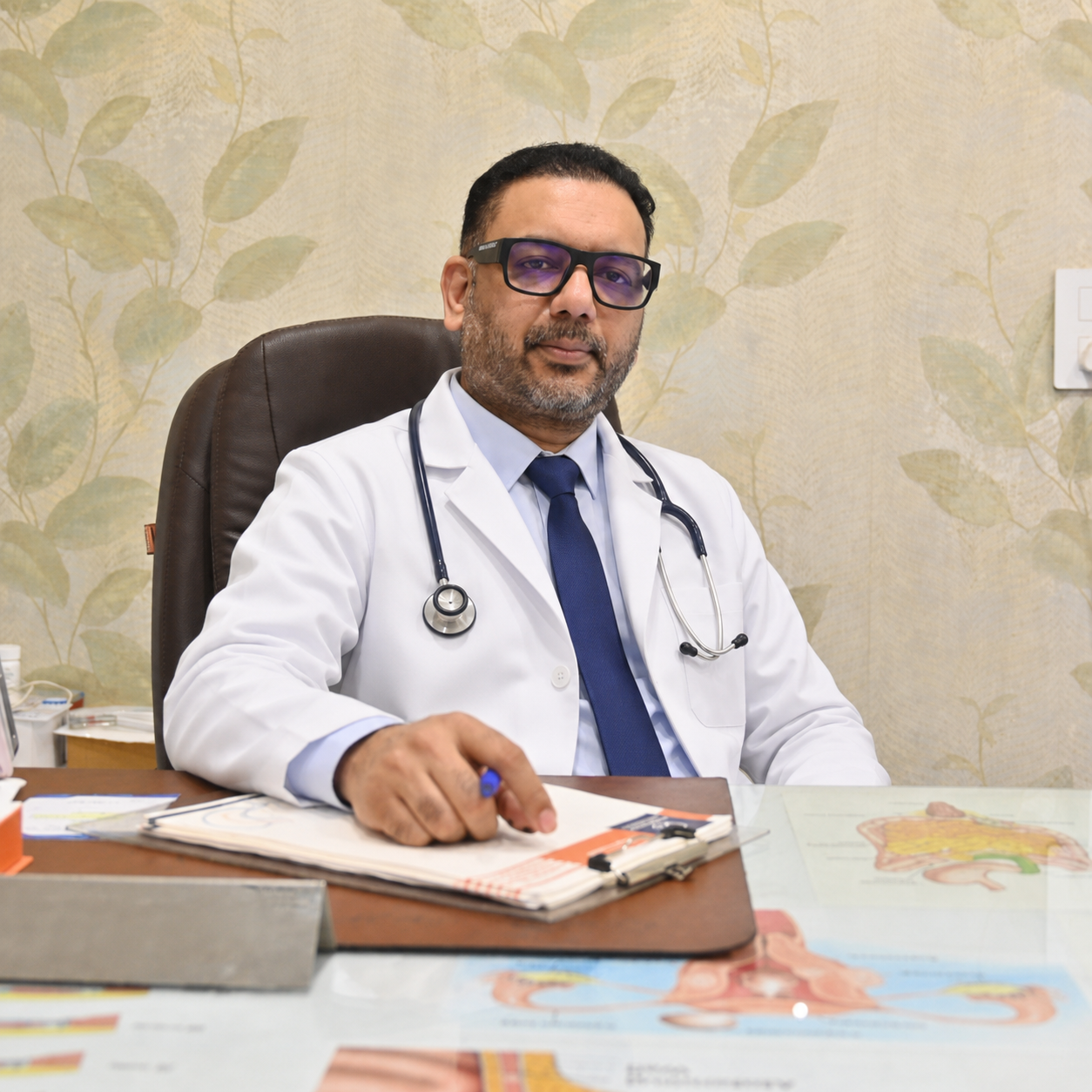
Answer box: Intestinal obstruction means the gut is blocked, so food, gas and fluid cannot pass. It is an emergency when pain, repeated vomiting and a swollen belly arrive together. Dr Raman Garg, surgical gastroenterologist at Bombay Gastro & Cancer Institute in Bathinda, Punjab, India, decides who needs drip and observation and who needs surgery, and operates himself.
What is intestinal obstruction (intestine blockage) in plain words?
Your intestine is a long tube, about 7 to 8 metres in an adult. Food moves through it in waves. In an obstruction, something stops that flow. The block can be inside the tube, in its wall, or from outside pressing on it.
Doctors talk about two types. A partial block lets a little gas or liquid pass. A complete block lets nothing pass. A complete block is more dangerous, because the gut above it swells and its blood supply can get squeezed. Gut that loses blood supply can die, and that is why time matters.
Small bowel obstruction is the most common. Large bowel obstruction involves the colon and is often linked to a growth. Dr Raman Garg is a surgical gastroenterologist, meaning a stomach, gut, liver, gallbladder and pancreas specialist who also operates. One doctor decides whether you need a drip, a scope or surgery, and does it.
Symptoms and when to worry
Think of obstruction when you see this group of signs:
- Cramping belly pain that comes in waves, then eases, then returns
- Repeated vomiting, sometimes green or foul-smelling
- Swollen, tight belly
- No stool and no gas passing (kabz with pet fulna)
- Loss of appetite and thirst
Red flags, go to a hospital the same day: constant severe belly pain, vomiting that will not stop, belly hard like a board, fever, fast heartbeat, blood in stool, or no stool and no gas for a day with a swollen belly. Do not wait for the OPD day. Call +91 82641-60001 and reach the nearest emergency room. Do not take laxatives or a "churan" when you suspect a block. They can make it worse.
Example: a 58 year old farmer from Maur Mandi had an old hernia operation scar, then two days of colicky pain, vomiting and no gas. That pattern points to a block from scar bands, and he needed same-day hospital care, not another home remedy.
Causes and risk factors
- Adhesions (scar bands) after earlier belly surgery, such as an appendix, caesarean or hernia operation. This is the most common cause in adults.
- Hernia, where a loop of gut gets trapped. See laparoscopic hernia surgery in Punjab and our hernia surgery page.
- Tumours of the colon or small bowel. See colon cancer surgery.
- Twisting of the gut (volvulus) and telescoping of the gut (intussusception).
- Narrowing from long-standing inflammation, such as Crohn's disease or tuberculosis of the gut.
- Severe long-standing constipation and hard stool lumps, mostly in the elderly.
- Gallstone that travels into the gut and blocks it, rare but real.
Risk goes up if you have had belly surgery before, have a hernia you have ignored, are over 60, or have had unexplained weight loss or change in bowel habit.
How Dr Raman Garg diagnoses it
First he examines you: pulse, hydration, belly swelling, scars, hernia sites and bowel sounds. Then tests are chosen. Blood tests, X-ray and ultrasound start the picture. A CT scan of the abdomen usually shows where the block is and why. CT is arranged with trusted imaging partners in Bathinda, and reports are reviewed by Dr Raman Garg the same day. Blood tests, including liver function, are done in our in-house laboratory.
| Test | Starting (Rs) | Average (Rs) | Maximum (Rs) |
|---|---|---|---|
| OPD consultation | 500 | 700 | 1,000 |
| Ultrasound abdomen | 600 | 1,000 | 1,800 |
| CT scan abdomen | 3,500 | 6,000 | 9,000 |
| Liver function test (LFT) | 400 | 600 | 1,200 |
| Pre-operative blood tests, ECG and chest X-ray | 1,500 | 2,500 | 4,000 |
Note: These are typical Punjab costs for 2026. The final cost may vary after Dr Raman Garg examines you, depending on the number of tests needed and your health.
Treatment options: drip first, surgery when needed
Not every blockage needs an operation. Honest answer first.
Without surgery (conservative care): many partial blocks from adhesions settle in 1 to 3 days with a drip, a tube through the nose to empty the stomach, nothing by mouth, and close watching. Doctors check pain, vomiting, belly size and gas passing every few hours. Most patients with a partial block who improve do not need an operation, though the block can return later.
Surgery is needed when:
- the block is complete and does not open in the watch period
- the belly is tender and rigid, or there is fever
- gut blood supply is at risk (strangulation)
- a hernia is trapped
- a tumour, twist or perforation is the cause
- the block keeps coming back
The decision is made by one surgeon watching you hour by hour, not by a relay of doctors. That is the benefit of a surgical gastroenterologist.
The surgery step by step
- Preparation. Drip, antibiotics when needed, pain relief, a nose tube, blood tests, consent discussion with your family.
- Anaesthesia. General anaesthesia, given by an anaesthetist.
- Access. In selected patients with a mild or early block, Dr Raman Garg can use the keyhole (laparoscopic) route through small cuts. When the gut is very swollen or the cause is complex, open surgery is the safer choice. The surgeon may start with keyhole and convert to open if safety needs it. That is a safety decision, not a failure.
- Find and fix the cause. Scar bands are cut (adhesiolysis). A trapped loop is released and its hernia repaired. A twisted segment is untwisted. A tumour or a dead segment is removed.
- Join or divert. After removal, the two healthy ends are joined (anastomosis). Sometimes a temporary stoma, an opening of the gut on the belly wall, is made for a few months to let the gut rest. This is explained to you before surgery wherever possible.
- Closure. Stitchless laparoscopic technique with skin glue is used for the small cuts when keyhole is possible.
Before and after: checklist and recovery
Before: stop eating and drinking as told, bring all old reports and the list of medicines, tell us about blood thinners and sugar medicines, keep a family member with you, keep your insurance card ready.
| Stage | What happens (most patients) |
|---|---|
| Day of surgery | Wake up in the recovery area, pain medicine, sips of water only when the surgeon allows |
| Day 1 to 2 | Walking with help, gentle start of liquids once the gut wakes up (gas passing is the sign) |
| Day 3 to 5 | Soft food, stitches and drains reviewed |
| Week 1 to 2 | Home rest, light walking, phone or video follow-up |
| Week 4 to 6 | Light work for most patients; heavy lifting after the surgeon allows |
Keyhole cases often go home sooner than open cases, and many keyhole patients walk the same day and may be discharged within 24 hours in simple cases. Recovery after a block that needed bowel removal or a stoma takes longer.
Risks and how they are handled
Every operation has risk, and obstruction surgery is done on a sick, dehydrated gut. Possible problems include infection of the wound, a leak at the joined gut, bleeding, chest infection, blood clots in the legs, and a return of adhesions. To reduce them we correct fluids and salts before surgery, give antibiotics, handle the gut gently, get you walking early, and watch you closely for the first days. If something does not look right, the same surgeon who operated sees you again.
Cost of intestinal obstruction surgery in Bathinda
| Item | Starting (Rs) | Average (Rs) | Maximum (Rs) |
|---|---|---|---|
| Intestinal obstruction surgery | 60,000 | 1,20,000 | 2,50,000 |
| Emergency surgery for perforation or bleeding ulcer (if that is the cause) | 70,000 | 1,10,000 | 1,80,000 |
| Colon cancer surgery (if a tumour is the cause) | 1,00,000 | 1,80,000 | 3,00,000 |
Note: These are typical Punjab costs for 2026. The final cost may vary after Dr Raman Garg examines you, depending on the cause of the blockage, how long it has been present, whether bowel has to be removed, keyhole or open approach, and your age and health.
Why the range is wide: a simple adhesion release sits near the starting figure. A long operation with bowel removal in an older patient with other illnesses sits nearer the maximum. Cancer drug treatment is not included in surgery figures. Keyhole costs more than open surgery because of equipment, but patients go home sooner and return to work earlier.
Insurance and cashless treatment
BGCI is empanelled with almost all major insurers and TPAs for cashless treatment, including Aditya Birla Health Insurance, Niva Bupa, Digit Insurance, Care Health Insurance, Vidal Health TPA, ICICI Lombard, Raksha TPA, Future Generali, SBI General Insurance, Oriental Insurance, Liberty General Insurance, IFFCO Tokio, Cholamandalam MS, Medi Assist TPA, and almost all other major insurers and TPAs.
- Call +91 82641-60001 or send your policy card on WhatsApp.
- The insurance desk checks your cover and arranges pre-authorisation.
- Dr Raman Garg's team sends the diagnosis and plan to the insurer.
- After treatment, the desk settles the claim directly with the insurer, as per your policy.
Ayushman Bharat: Call us with your card details and our insurance desk will tell you the same day how your card can be used. See cashless insurance for gastro treatment.
Facilities at BGCI
- Modern laparoscopic operation theatre for keyhole and open abdominal surgery
- Advanced endoscopy and colonoscopy suite
- Fully equipped in-house diagnostic laboratory for blood tests
- CT and other imaging arranged with trusted imaging partners in Bathinda, with reports reviewed by Dr Raman Garg the same day
- Comfortable patient rooms
- 24/7 emergency care support on +91 82641-60001
- Cashless insurance desk
- Stitchless laparoscopic technique with skin glue
- One surgeon from consultation to follow-up
- Online pre-arrival consultation for out-of-town and NRI patients: share reports on WhatsApp
- Follow-up by phone or video
Why patients choose Dr Raman Garg
- 20+ years as a surgeon, with 10,000+ laparoscopic surgeries, including 1,000+ laparoscopic hernia repairs
- MBBS (Government Medical College, Patiala); MS General Surgery (Dayanand Medical College & Hospital, Ludhiana); DNB Surgical Gastroenterology (Lilavati Hospital and Research Centre, Mumbai); Fellowship in Advanced Laparoscopic Surgery; advanced laparoscopy training in Seoul, South Korea
- Registered with the Dubai Health Authority as Physician Specialist, Gastrointestinal Surgery; member of IAGES and AMASI
- First surgical gastroenterologist in the Malwa belt of Punjab
- Honest advice: a drip and watching first when that is safe, surgery when it is needed
Read more about Dr Raman Garg.
Patients we see from your area
Patients reach BGCI from Rampura Phul (30 km, 40 min), Mansa (50 km, 1 hr), Muktsar (55 km, 1 hr 10 min) and many other towns. See all areas we serve. If a blockage is suspected, do not drive for an hour on a swollen, painful belly without first calling +91 82641-60001; we will tell you the safest way to reach us, and your nearest emergency room comes first.
How to book
- Call or WhatsApp +91 82641-60001 or +91 99885-03800.
- Send your reports (ultrasound, CT, blood tests, old surgery papers) on WhatsApp for a first look.
- Visit OPD, Monday to Saturday, 10 AM to 5 PM. Sunday is emergency only. Emergency care support is available 24/7 on +91 82641-60001.
- Address: Bombay Gastro & Cancer Institute, Power House Road, Near Street No. 10, Bathinda, Punjab 151001, India. Email: bgcibathinda@gmail.com.
- OPD consultation Rs 500 to 1,000.
This page is general information; your plan is set after Dr Raman Garg examines you.
Related pages
Gastro emergency in Bathinda | Appendicitis surgery | Hernia surgery | Laparoscopic surgery | Constipation treatment | Gastro treatment hub | Treatment cost | Gastro doctor in Bathinda | Gastro hospital
Read next: When to see a gastro doctor and Laparoscopic surgery benefits and recovery.
Medically reviewed by Dr Raman Garg. Last updated: 8 November 2026