
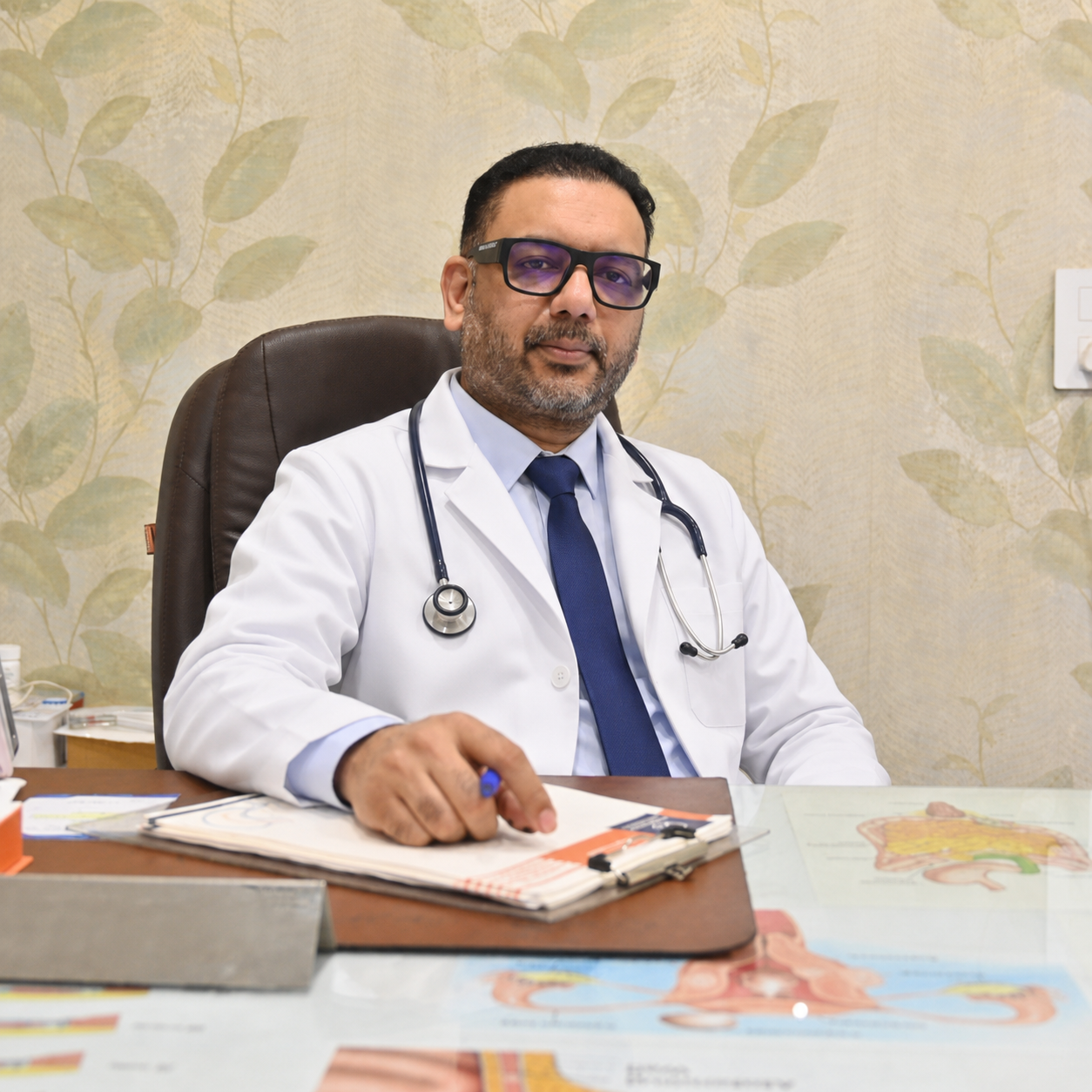
Answer box: A GI cancer surgeon operates on cancers of the digestive system: the rectum, pancreas, liver, food pipe, stomach and colon. Dr Raman Garg, surgical gastroenterologist at Bombay Gastro & Cancer Institute in Bathinda, Punjab, India, examines you, plans the tests, explains the options honestly and performs the surgery himself, so you have one doctor from first visit to follow-up.
This page gives an overview of four cancers: rectum, pancreas, liver and oesophagus (food pipe). For stomach cancer and colon cancer, we have separate pages: stomach cancer surgery and colon cancer surgery.
What is GI cancer, in plain words?
GI stands for gastrointestinal, meaning the food tube and its helper organs. The tube runs from the food pipe through the stomach, small gut, colon and rectum to the back passage. The helpers are the liver, gallbladder and pancreas. A cancer in any of these is called a GI cancer.
A surgical gastroenterologist is a stomach, gut, liver, gallbladder and pancreas specialist who also operates. That is the right kind of doctor to see first, because he knows every organ in this region and also does the operation. See more about Dr Raman Garg.
The four cancers at a glance
| Cancer | What it is | Common warning signs | How surgery helps |
|---|---|---|---|
| Rectum | Growth in the last part of the large gut | Blood in stool, mucus, change in bowel habit, feeling of incomplete motion, narrow stool | Removes the growth and nearby glands; sometimes the bowel is joined back, sometimes a temporary or permanent stoma (bag) is needed |
| Pancreas | Growth in the gland behind the stomach that makes digestive juices and insulin | Yellow eyes and skin, back pain, weight loss, pale stool, new diabetes | Whipple operation for growths in the head of the pancreas; other operations for the body and tail |
| Liver | Growth in the liver, either starting there or spreading from elsewhere | Pain in upper right belly, swelling, weight loss, jaundice, history of hepatitis B or C or cirrhosis | Removes the part of liver holding the growth when the remaining liver is healthy enough |
| Oesophagus (food pipe) | Growth in the tube from throat to stomach | Food sticking while swallowing, weight loss, pain on swallowing, vomiting | Removes the diseased part of the food pipe and rebuilds it using the stomach; often combined with other treatment |
Symptoms and when to worry
One rule covers all four: a new symptom that lasts more than two to three weeks, or keeps returning, needs a proper check. Do not treat it with home remedies for months.
- Blood in stool that is not clearly piles, or a change in bowel habit lasting weeks. See blood in stool treatment.
- Yellow eyes or skin, dark urine, pale stool. See jaundice treatment.
- Food sticking in the chest or throat. See swallowing problem treatment.
- Unexplained weight loss, loss of appetite, constant back or belly pain.
Red flags, go to a hospital the same day: vomiting blood, heavy bleeding from the back passage, fever with yellow eyes, severe constant belly pain, or being unable to swallow even water. Call +91 82641-60001 and reach the nearest emergency room first.
Example: a 62 year old from Talwandi Sabo thought his bleeding was piles for a year. A colonoscopy showed a growth in the rectum. Early checking would have shortened the road for him, and that is the point of getting any lasting bleeding examined.
Causes and risk factors
- Rectum: age above 50, family history, polyps, long-standing bowel inflammation, low-fibre and high red-meat diet, smoking.
- Pancreas: smoking, long-standing pancreatitis, diabetes of recent onset in older adults, family history.
- Liver: hepatitis B or C, cirrhosis, heavy alcohol, fatty liver over many years. See fatty liver treatment.
- Oesophagus: long-standing acid reflux, smoking, tobacco chewing, very hot drinks and alcohol. See acid reflux and GERD treatment.
Risk factors are not a diagnosis. They only tell you when to be alert.
How Dr Raman Garg diagnoses and stages it
He begins with a detailed talk and examination. Then the tests that fit the organ: colonoscopy with biopsy for the rectum; upper GI endoscopy for the food pipe; ultrasound and CT scan for the pancreas and liver; and blood tests including liver function and tumour markers. Scope tests and blood tests are done at our hospital. CT, MRCP and similar scans are arranged with trusted imaging partners in Bathinda, and reports are reviewed by Dr Raman Garg the same day. Staging means finding out how far the cancer has gone. It decides whether surgery comes first or other treatment comes first.
| Test | Starting (Rs) | Average (Rs) | Maximum (Rs) |
|---|---|---|---|
| OPD consultation (also second opinion) | 500 | 700 | 1,000 |
| Ultrasound abdomen | 600 | 1,000 | 1,800 |
| Colonoscopy with biopsy or polyp removal | 7,000 | 10,000 | 18,000 |
| Upper GI endoscopy (gastroscopy) | 2,000 | 3,200 | 5,000 |
| CT scan abdomen | 3,500 | 6,000 | 9,000 |
| MRCP (bile duct and pancreas scan) | 4,000 | 7,000 | 12,000 |
| CEA tumour marker | 500 | 650 | 1,000 |
| Biopsy report (histopathology), per sample | 800 | 1,500 | 3,000 |
| Liver function test (LFT) | 400 | 600 | 1,200 |
Note: These are typical Punjab costs for 2026. The final cost may vary after Dr Raman Garg examines you, depending on the organ involved, the number of tests needed and your health.
Treatment options
Surgery is the main treatment when the cancer can be removed. Some cancers also need chemotherapy or radiation, given by a cancer physician before or after the operation. For some, such as many rectal cancers, that treatment comes first to shrink the growth. For others, surgery comes first. Dr Raman Garg tells you which path fits your reports and coordinates with the cancer physician so that the timing is right.
He will also say plainly when surgery is not the right first step, or when the aim is comfort and relief of symptoms rather than removal. Relief matters: easing jaundice, bleeding, blockage or pain can improve how you feel and eat.
The operations in simple words
- Rectal cancer: the diseased part of the rectum and nearby glands are removed. Keyhole surgery is often used where suitable. If the gut cannot be joined safely, a stoma may be needed for some months or longer. This is discussed with you before surgery.
- Pancreatic cancer: the Whipple operation removes the head of the pancreas, part of the small gut and the bile duct end, then reconnects everything. It is a long and demanding operation and is advised only after careful staging.
- Liver cancer: a liver resection removes the part with the growth. The liver can regrow, but only if the rest is healthy, so liver function tests and scans decide this.
- Oesophageal cancer: the diseased part of the food pipe is removed and the stomach is lifted up to form a new food tube. Often it is planned together with other treatment.
The first three steps are the same in every case: anaesthesia, careful removal, joining or rebuilding the gut, and sending everything removed for histopathology. That report gives the final stage.
Before and after: preparation and recovery
Preparation checklist: bring all reports; list all medicines; stop tobacco and alcohol; eat protein-rich food; get heart, lung and blood sugar checks; correct anaemia; carry your insurance card.
| When | What usually happens |
|---|---|
| Day of surgery | Operation and close watching |
| Day 1 to 3 | Sitting up, first walking, breathing exercises |
| Day 3 to 7 | Liquids then soft food, depending on the operation |
| Week 2 | Wound check, histopathology discussion, plan for further treatment |
| Week 4 to 8 | Most patients return to light work; larger operations take longer |
Recovery varies by organ and by the size of operation. Follow-up is by phone or video if travel is hard.
Risks and how they are handled
These are major operations. Risks include bleeding, infection, leaks from the joined gut, blood clots, chest infection, delayed stomach emptying after pancreatic surgery, and liver function problems after liver resection. Careful staging, nutrition before surgery, early walking and close monitoring reduce these. Dr Raman Garg explains the risks that apply to you before consent.
Cost of GI cancer surgery in Punjab
| Item | Starting (Rs) | Average (Rs) | Maximum (Rs) |
|---|---|---|---|
| Other GI cancer surgery (rectum, pancreas, liver), planned | 1,50,000 | 2,50,000 | 4,50,000 |
| Colon cancer surgery (laparoscopic or open) | 1,00,000 | 1,80,000 | 3,00,000 |
| Stomach cancer surgery (gastrectomy) | 1,50,000 | 2,50,000 | 4,00,000 |
Cancer drug treatment (chemotherapy, radiation) is not included in surgery figures. For food pipe surgery, the plan and cost are explained at your visit after tests, because they depend on the stage and the combination of treatments.
Note: These are typical Punjab costs for 2026. The final cost may vary after Dr Raman Garg examines you, depending on the organ involved, stage of disease, type of procedure chosen, and your health.
See the full gastro treatment cost list.
Insurance and cashless
BGCI is empanelled with almost all major insurers and TPAs for cashless treatment, including Aditya Birla Health Insurance, Niva Bupa, Digit Insurance, Care Health Insurance, Vidal Health TPA, ICICI Lombard, Raksha TPA, Future Generali, SBI General Insurance, Oriental Insurance, Liberty General Insurance, IFFCO Tokio, Cholamandalam MS, Medi Assist TPA, and almost all other major insurers and TPAs. Ayushman Bharat: Call us with your card details and our insurance desk will tell you the same day how your card can be used.
- Send policy or card details on WhatsApp.
- The insurance desk checks cover and arranges pre-authorisation.
- You receive a clear estimate before admission.
- The desk handles claim paperwork after discharge. See cashless insurance.
Facilities at BGCI
A modern laparoscopic operation theatre; an advanced endoscopy and colonoscopy suite for diagnosis and biopsy; a fully equipped in-house diagnostic laboratory; comfortable patient rooms; 24/7 emergency care support; a cashless insurance desk; the stitchless laparoscopic technique with skin glue where keyhole is used; one surgeon from consultation to follow-up; and online pre-arrival consultation for out-of-town and NRI patients. Scans are arranged with trusted imaging partners in Bathinda. See the gastro hospital in Bathinda.
Why patients choose Dr Raman Garg
- A surgical gastroenterologist with 20+ years and 10,000+ laparoscopic surgeries, trained through DNB Surgical Gastroenterology at Lilavati Hospital and Research Centre, Mumbai, and advanced laparoscopy training in Seoul, South Korea.
- First surgical gastroenterologist in the Malwa belt of Punjab, so you can get an expert opinion close to home.
- Honest advice, including when surgery is not the first step. A second opinion is welcome.
- Member of IAGES and AMASI; registered with the Dubai Health Authority as Physician Specialist, Gastrointestinal Surgery.
Patients we see from your area
Families come from Goniana Mandi, Talwandi Sabo, Mansa, Muktsar, Barnala and across Punjab, India. See areas we serve.
How to book
- Call or WhatsApp +91 82641-60001 (or +91 99885-03800).
- Send your scan, scope and biopsy reports on WhatsApp for review.
- Visit the OPD, Monday to Saturday, 10 AM to 5 PM. Sunday is emergency only.
- Leave with a plan the same day. Book an appointment.
Address: Bombay Gastro & Cancer Institute, Power House Road, Near Street No. 10, Bathinda, Punjab 151001, India. Email: bgcibathinda@gmail.com. Emergency care support 24/7 on +91 82641-60001.
This page is general information; your plan is set after Dr Raman Garg examines you.
Related pages
Stomach cancer surgery | Colon cancer surgery | Laparoscopic surgery | Colonoscopy | Early signs of colon cancer | Blood in stool: when to worry | Gastro doctor in Bathinda | All gastro treatments
Medically reviewed by Dr Raman Garg. Last updated: 8 November 2026.