
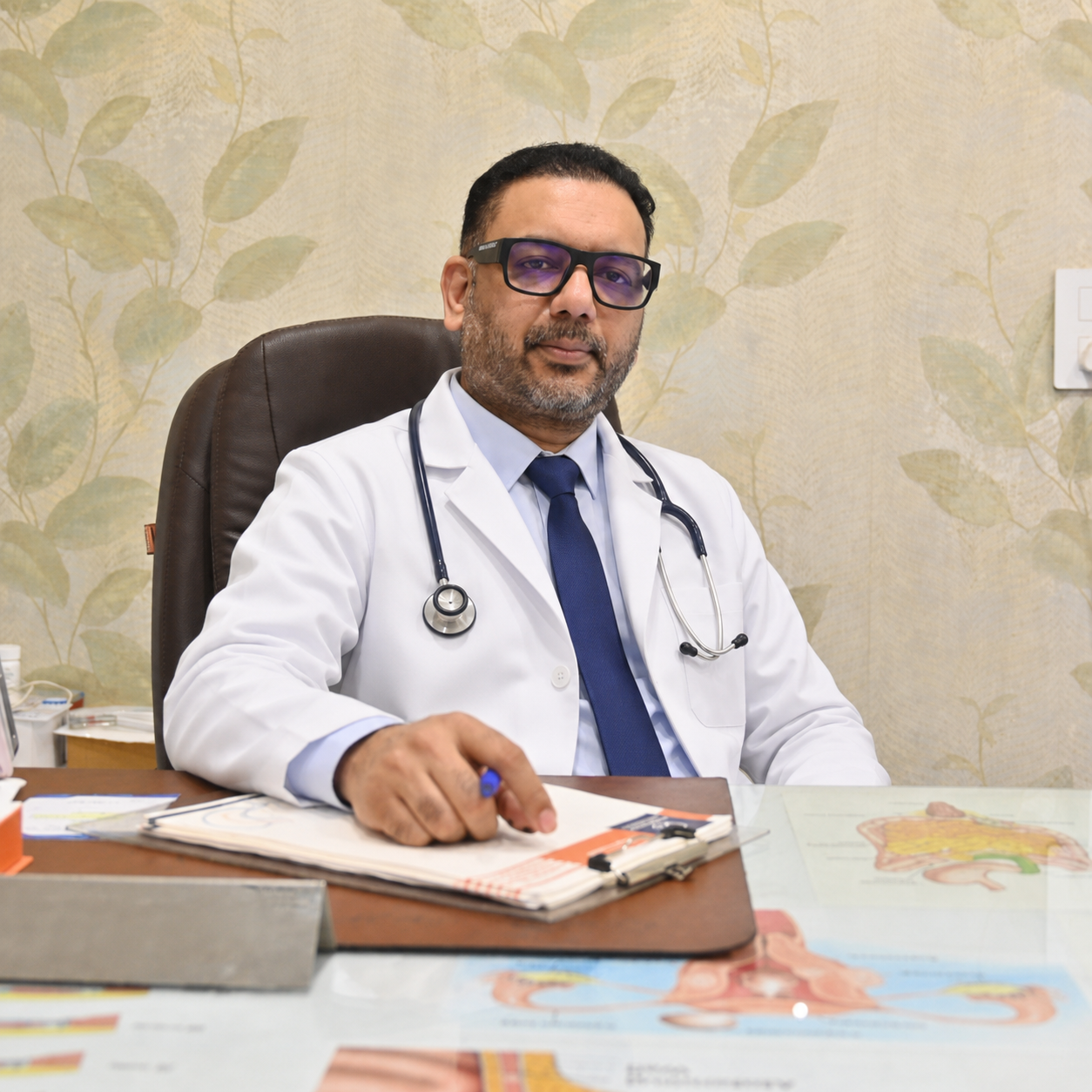
Answer box: Stomach cancer surgery removes the part of the stomach that holds the growth, along with nearby lymph glands. Dr Raman Garg, surgical gastroenterologist at Bombay Gastro & Cancer Institute in Bathinda, Punjab, India, examines you, arranges the scope and scan tests, explains each step calmly, and operates himself. Many patients come for a second opinion first, and that is welcome.
If you or someone at home has just heard the word cancer, take a breath. A diagnosis is a starting point for a plan, not the end of the road. This page tells you in simple words what the surgery involves, what the tests are, what the weeks after look like and what it costs, so that you can decide with a clear head.
What is stomach cancer, in plain words?
The stomach is the bag under your left ribs where food is mixed with acid before it moves on. Stomach cancer (also called gastric cancer, or pet ka cancer) starts when cells in its inner lining grow in a way the body cannot control. A small growth may sit quietly for a long time. A larger one can block food, bleed, or spread to nearby glands.
A surgical gastroenterologist is a stomach, gut, liver, gallbladder and pancreas specialist who also operates. For stomach cancer this matters, because the same doctor who looks inside with the scope also plans and performs the operation. You do not get passed from one person to another.
Symptoms and when to worry
Early stomach cancer often feels like ordinary acidity, which is why people ignore it for months. Watch for these:
- Burning, heaviness or pain in the upper belly that does not settle with a normal course of acidity medicines
- Feeling full after a few bites, or loss of appetite
- Weight loss you cannot explain
- Repeated vomiting, or food getting stuck
- Black, tarry stool (bleeding from the stomach) or vomiting blood
- Tiredness and looking pale (anaemia)
Red flags, go to a hospital the same day: vomiting blood, black tarry stool with dizziness, constant severe belly pain, or being unable to keep any food or water down. Call +91 82641-60001 and reach the nearest emergency room first.
Example: a 56 year old shopkeeper from Giddarbaha took acidity tablets for eight months. Only when his weight fell and his stool turned black did he get a scope test. If your acidity lasts more than three weeks despite medicines, or returns every time you stop them, get an upper GI endoscopy done. See our page on acidity and gas treatment.
Causes and risk factors
No single cause is known. Things that raise the chance are:
- Long-standing infection with H pylori, a stomach germ (see H pylori treatment)
- Age above 50, and being male
- Smoking, tobacco and heavy alcohol
- Very salty, smoked or pickled food and few fresh vegetables
- Long-standing stomach ulcer or inflammation of the stomach lining
- A close family member with stomach cancer
Having risk factors does not mean you have cancer. It means a scope test is worth doing when symptoms appear.
How Dr Raman Garg diagnoses it
First, a talk and an examination. Then the key test: upper GI endoscopy, where a thin camera tube goes down the food pipe so the doctor sees the stomach lining. If anything looks wrong, tiny samples (biopsy) are taken and sent for histopathology to confirm what the cells are. The scope suite and the blood tests are at our hospital. A CT scan of the abdomen shows whether glands or other organs are involved, and it is arranged with trusted imaging partners in Bathinda, with reports reviewed by Dr Raman Garg the same day.
| Test | Starting (Rs) | Average (Rs) | Maximum (Rs) |
|---|---|---|---|
| OPD consultation (also second opinion) | 500 | 700 | 1,000 |
| Upper GI endoscopy (gastroscopy) | 2,000 | 3,200 | 5,000 |
| Biopsy report (histopathology), per sample | 800 | 1,500 | 3,000 |
| CT scan abdomen | 3,500 | 6,000 | 9,000 |
| CEA tumour marker | 500 | 650 | 1,000 |
| Pre-operative blood tests, ECG and chest X-ray | 1,500 | 2,500 | 4,000 |
Note: These are typical Punjab costs for 2026. The final cost may vary after Dr Raman Garg examines you, depending on the number of tests needed, biopsy samples taken and your health.
Treatment options
Surgery is the main treatment for stomach cancer that can be removed. Whether other treatment is needed before or after depends on the biopsy and scan findings. The plan is made for you, and Dr Raman Garg will tell you plainly which parts apply.
- Surgery (gastrectomy): removes the cancer with a margin of healthy stomach and the nearby lymph glands.
- Chemotherapy or radiation: medicines or beams given by a cancer physician, sometimes before surgery, sometimes after. These are separate from the operation.
- Supportive care: nutrition, anaemia correction, and treatment of bleeding or blockage so you are strong enough for the operation.
- Palliative procedures: when a growth cannot be removed, surgery or other steps can still ease vomiting, bleeding or pain.
A multi-disciplinary view matters. Where chemotherapy or radiation is advised, Dr Raman Garg coordinates with the treating cancer physician so that the timing fits.
The procedure step by step
There are two main operations. In a subtotal gastrectomy, the lower part of the stomach is removed and the rest is joined to the small gut. In a total gastrectomy, the whole stomach is removed and the food pipe is joined directly to the small gut. Which one you need depends on where the growth sits.
- Anaesthesia is given and you sleep through the operation.
- The surgeon reaches the stomach by keyhole (laparoscopic) or open surgery, whichever is safer for your case. Keyhole is used where the stage and location allow.
- The part of the stomach with the growth is removed, along with nearby lymph glands.
- The remaining gut is joined so food can pass again.
- A feeding plan is set, sometimes with a thin tube placed for early nutrition.
- Everything removed is sent for histopathology. This report tells the final stage and whether more treatment is advised.
Before and after: preparation and recovery
Preparation checklist: bring all reports and scan films; share your medicine list (especially blood thinners and sugar medicines); stop tobacco; eat protein-rich food and take any iron or nutrition advised; get fitness tests for the heart and lungs; carry your insurance card.
| When | What usually happens |
|---|---|
| Day of surgery | Operation, then close watching; sips of water start when advised |
| Day 1 to 3 | Walking with help, breathing exercises, pain care |
| Day 3 to 7 | Liquids, then soft food in small amounts as the gut recovers |
| Week 2 | Wound check, histopathology report discussion, plan for next treatment |
| Week 4 to 6 | Most patients return to light daily work |
Timelines differ for each person. After a gastrectomy you eat small meals, six or more a day, chew well and avoid sweet drinks right after food. Dr Raman Garg gives you a written diet plan, and follow-up is by phone or video if travel is hard.
Risks and how they are handled
Gastrectomy is a major operation, and every major operation carries risks. They include bleeding, infection, a leak at the join of the gut, blood clots in the legs, chest infection, and trouble with eating or low vitamin B12 and iron in the long run. These are reduced by careful selection, nutrition before surgery, early walking, blood thinners where needed, and close monitoring. Dr Raman Garg will explain the risks that apply to your age, health and operation before you sign consent.
Cost of stomach cancer surgery in Punjab
| Item | Starting (Rs) | Average (Rs) | Maximum (Rs) |
|---|---|---|---|
| Stomach cancer surgery (gastrectomy) | 1,50,000 | 2,50,000 | 4,00,000 |
Cancer drug treatment (chemotherapy, radiation) is not included in surgery figures.
Note: These are typical Punjab costs for 2026. The final cost may vary after Dr Raman Garg examines you, depending on the stage of disease, whether the whole or part of the stomach is removed, type of procedure chosen, and your health.
For full price lists, see gastro treatment cost in Bathinda.
Insurance and cashless
BGCI is empanelled with almost all major insurers and TPAs for cashless treatment, including Aditya Birla Health Insurance, Niva Bupa, Digit Insurance, Care Health Insurance, Vidal Health TPA, ICICI Lombard, Raksha TPA, Future Generali, SBI General Insurance, Oriental Insurance, Liberty General Insurance, IFFCO Tokio, Cholamandalam MS, Medi Assist TPA, and almost all other major insurers and TPAs. Ayushman Bharat: Call us with your card details and our insurance desk will tell you the same day how your card can be used.
- Send your policy or card details on WhatsApp.
- The insurance desk checks cover and sends pre-authorisation.
- You get a clear estimate before admission.
- After discharge the desk settles the claim paperwork. Details: cashless insurance for gastro treatment.
Facilities at BGCI
A modern laparoscopic operation theatre; an advanced endoscopy and colonoscopy suite for scope tests and biopsies; a fully equipped in-house diagnostic laboratory; comfortable patient rooms; 24/7 emergency care support; a cashless insurance desk; the stitchless laparoscopic technique with skin glue where keyhole is used; one surgeon from consultation to follow-up; and an online pre-arrival consultation for out-of-town and NRI patients, where you share reports on WhatsApp. CT and similar scans are arranged with trusted imaging partners in Bathinda. More on the gastro hospital in Bathinda.
Why patients choose Dr Raman Garg
- Surgeon-level care: a surgical gastroenterologist with 20+ years and 10,000+ laparoscopic surgeries. Read his qualifications and approach.
- Training: DNB Surgical Gastroenterology from Lilavati Hospital and Research Centre, Mumbai, and advanced laparoscopy training in Seoul, South Korea.
- Straight talk: he tells you what is known, what is not, and what the options are, without frightening you.
- First surgical gastroenterologist in the Malwa belt of Punjab, so you do not need to travel to a metro for a first opinion.
- Second opinions are welcome. See second opinion for gastro surgery.
Patients we see from your area
Patients travel to us from Goniana Mandi (12 km), Rampura Phul (30 km), Mansa (50 km), Muktsar (55 km), Malout (60 km), Faridkot (65 km) and across Punjab, India. See all areas we serve.
How to book
- Call or WhatsApp +91 82641-60001 (or +91 99885-03800).
- Send your endoscopy, biopsy and scan reports on WhatsApp. Dr Raman Garg reviews them before you arrive.
- Visit the OPD, Monday to Saturday, 10 AM to 5 PM. Sunday is emergency only.
- Get your plan the same day. Book an appointment.
Address: Bombay Gastro & Cancer Institute, Power House Road, Near Street No. 10, Bathinda, Punjab 151001, India. Email: bgcibathinda@gmail.com. Emergency care support 24/7 on +91 82641-60001.
This page is general information; your plan is set after Dr Raman Garg examines you.
Related pages
Colon cancer surgery | GI cancer surgery | Laparoscopic surgery | Upper GI endoscopy | Early signs of stomach cancer | Stomach ulcer symptoms and diet | Gastro doctor in Bathinda | All gastro treatments
Medically reviewed by Dr Raman Garg. Last updated: 8 November 2026.