
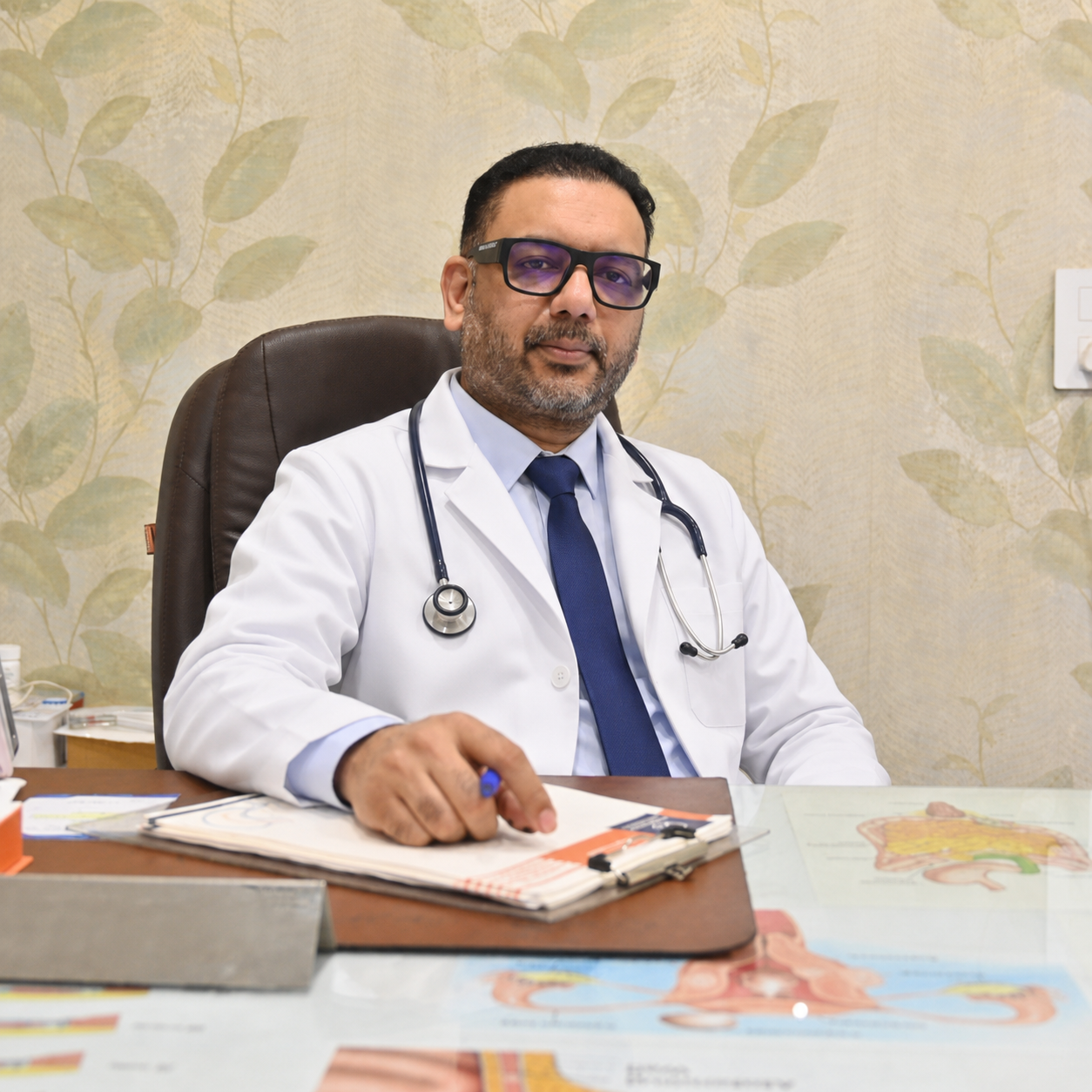
Answer box: A hiatal hernia is when part of your stomach slides up through a small gap in the diaphragm, the muscle sheet between chest and belly. It often shows up as heartburn and food coming back up. Dr Raman Garg, surgical gastroenterologist at Bombay Gastro & Cancer Institute, Bathinda, Punjab, India, tests it and treats it with medicines or keyhole surgery.
What is a hiatal hernia, in plain words?
Your food pipe passes from the chest into the belly through a small opening in the diaphragm. This opening is called the hiatus. In a hiatal hernia (hiatus hernia), that opening becomes loose or wide, and the top part of the stomach slides up into the chest.
Most people with a small hiatal hernia never know they have it. It is often found by chance during an endoscopy, which is a camera test of the food pipe and stomach. The trouble starts when the hernia lets stomach acid flow back up. That is why many people first meet this problem as acidity, burning in the chest or khatti dakar.
There are two main types. A sliding hernia is the common one, where the stomach moves up and down through the gap. A paraoesophageal hernia is rarer, where a part of the stomach sits next to the food pipe in the chest. This second type needs closer watching because it can get stuck or twisted.
If you want the background on reflux itself, read our page on acid reflux and GERD treatment in Bathinda. For the full hernia library, see laparoscopic hernia surgery in Punjab.
Symptoms and when to worry
Common signs are:
- Burning in the chest or throat, worse after meals or when lying down (seene mein jalan)
- Sour water or food coming back into the mouth
- A feeling of food stuck behind the breastbone (khana atakna, nigalne me dikkat)
- Belching, bloating and a full feeling after a small meal
- Chest discomfort that is not linked to walking or climbing stairs
- Dry cough or hoarse voice in the morning from acid reaching the throat
Seema, a 52 year old teacher from Maur Mandi, took antacids for six years. Her burning was worst at night and she slept on three pillows. An endoscopy showed a hiatal hernia with a damaged food pipe lining. Stories like this are common. Long years of silent reflux is how many hernias are found.
Red flags: get same-day hospital care. Go to a hospital the same day, or call +91 82641-60001, if you have sudden severe chest or upper belly pain, repeated vomiting that will not stop, vomiting blood, black tarry stool, food that will not go down at all, or breathlessness with chest pain. Any chest pain with sweating or pain going to the arm needs an emergency room first, because heart attack must be ruled out.
Causes and risk factors
The gap widens when the muscle around it weakens or when pressure inside the belly keeps pushing upward. Common reasons:
- Age above 50, as tissues loosen
- Being overweight, especially a large belly
- Long-standing cough, constipation with straining, or heavy lifting at work
- Pregnancy
- Smoking and tobacco chewing
- Very large, late-night meals and lying down soon after eating
- Born with a wider opening
Farmers and labourers who lift sacks all day, and shopkeepers who sit long hours and eat late, are two groups we see often from the Malwa belt.
How Dr Raman Garg diagnoses a hiatal hernia
Dr Raman Garg first listens to your story and examines you. Then he picks only the tests that change your treatment.
- Upper GI endoscopy: a thin camera passes through the mouth after a numbing spray or light sedation. It shows the hernia, any food pipe damage and ulcers.
- Barium swallow: an X-ray taken as you drink a thick liquid. It shows the shape of the stomach and food pipe.
- GERD pH study and manometry: used when surgery is being planned, to measure acid and food pipe muscle strength.
- Blood tests: in our in-house laboratory, to check for anaemia and fitness for surgery.
Barium swallow, pH study and manometry are arranged with trusted imaging partners in Bathinda, and reports are reviewed by Dr Raman Garg the same day.
| Item | Starting (Rs) | Average (Rs) | Maximum (Rs) |
|---|---|---|---|
| OPD consultation | 500 | 700 | 1,000 |
| Upper GI endoscopy (gastroscopy) | 2,000 | 3,200 | 5,000 |
| Barium swallow | 1,200 | 2,000 | 3,500 |
| GERD pH study | 3,000 | 5,000 | 8,000 |
| GERD manometry | 4,000 | 7,000 | 12,000 |
Note: These are typical Punjab costs for 2026. The final cost may vary after Dr Raman Garg examines you, depending on the number of tests needed and your health.
Read more on the camera test at endoscopy in Bathinda.
Treatment options: medicines first, surgery only when needed
Most people with a hiatal hernia do not need an operation. This is the honest picture.
Lifestyle and medicines (first step for most patients). Eat smaller meals. Stop eating 3 hours before sleep. Raise the head end of the bed by 6 inches. Lose weight if you are overweight. Stop tobacco. Acid-reducing medicines, taken as advised by Dr Raman Garg, settle symptoms in many patients. Our page on gas, acidity and bloating treatment and the blog on GERD diet and foods to avoid help with daily habits.
Surgery (when medicines are not enough or the hernia is risky). Dr Raman Garg may advise surgery if:
- You still have severe reflux despite months of proper medicines
- You need medicines for life and are unhappy with that, or have side effects
- The food pipe lining is damaged or there is regurgitation reaching the lungs
- You have a large or paraoesophageal hernia
- Food is getting stuck, or you are anaemic from slow bleeding
The surgery is a laparoscopic hiatal hernia repair with fundoplication. In plain words, the surgeon pulls the stomach back into the belly, tightens the widened gap with stitches, and wraps the top of the stomach loosely around the lower food pipe. This wrap acts like a new valve that keeps acid down.
If swallowing is your main worry, see swallowing problem treatment in Bathinda.
The procedure step by step
- Anaesthesia: you are put to sleep with general anaesthesia by the anaesthetist.
- Small cuts: four or five small openings, each about the size of a button, are made in the belly. A camera and fine instruments go in.
- Bringing the stomach down: the hernia is gently pulled back into the belly.
- Closing the gap: the widened hiatus is narrowed with strong stitches. Sometimes a mesh is used for very large gaps, and Dr Raman Garg decides this during surgery.
- Fundoplication: the top of the stomach is wrapped around the lower food pipe, loose enough to let food pass.
- Closure: the cuts are closed with the stitchless technique using skin glue.
The operation usually takes 1.5 to 3 hours. For more on how keyhole surgery works, read laparoscopic surgery in Bathinda.
Before and after: preparation, timeline and recovery
Preparation checklist
- Bring your old endoscopy, barium and blood reports
- Tell us all medicines you take, especially blood thinners and sugar tablets
- Pre-operative blood tests, ECG and chest X-ray
- No food for 8 hours and no water for 4 hours before surgery
- Stop tobacco at least 2 weeks before
Recovery timeline
| When | What most patients can expect |
|---|---|
| Day of surgery | Wake up in the recovery area, sip water in the evening, short walk with help |
| Day 1 | Liquids and soft food, walking, most go home within 24 hours |
| Week 1 | Soft food in small portions, light walking, no lifting |
| Weeks 2 to 3 | Desk work and normal home life for most patients |
| Weeks 4 to 6 | Back to heavy work, farm work and lifting, as advised |
Note on swallowing: for the first few weeks the new wrap can make food feel tight. Most patients find this settles with small, slow bites and soft food. Dr Raman Garg follows you by phone or video call so you do not guess alone.
Risks and how they are handled
Every operation has risks. For hiatal hernia repair these include temporary difficulty swallowing, gas and bloating, the hernia coming back over the years, bleeding, infection, and injury to nearby organs. Anaesthesia has its own risks, which are checked in your pre-surgery tests.
They are lowered by choosing patients carefully, doing the full set of tests, using a single surgeon from consultation to follow-up, and a clear plan if something looks wrong. If you notice fever, increasing belly pain, repeated vomiting or you cannot swallow even liquids after surgery, call +91 82641-60001 the same day.
Cost of hiatal hernia surgery in Bathinda
| Item | Starting (Rs) | Average (Rs) | Maximum (Rs) |
|---|---|---|---|
| Hiatal hernia repair with fundoplication (for severe reflux) | 90,000 | 1,30,000 | 2,00,000 |
| Upper GI endoscopy | 2,000 | 3,200 | 5,000 |
| Pre-operative blood tests, ECG and chest X-ray | 1,500 | 2,500 | 4,000 |
Note: These are typical Punjab costs for 2026. The final cost may vary after Dr Raman Garg examines you, depending on the size and type of the hernia, whether a mesh is needed, the type of anaesthesia, your age and other illnesses, and your health.
See all prices on gastro treatment cost in Bathinda. Hospital prices in metro cities are often higher. Keyhole surgery costs more than open surgery because of the equipment, but patients go home sooner and return to work earlier. For hernia cost reading from our dedicated site, see hernia surgery cost in Punjab.
Insurance and cashless treatment
Bombay Gastro & Cancer Institute is empanelled with almost all major insurers and TPAs for cashless treatment, including Aditya Birla Health Insurance, Niva Bupa, Digit Insurance, Care Health Insurance, Vidal Health TPA, ICICI Lombard, Raksha TPA, Future Generali, SBI General Insurance, Oriental Insurance, Liberty General Insurance, IFFCO Tokio, Cholamandalam MS, Medi Assist TPA, and almost all other major insurers and TPAs.
- Send your policy card and reports on WhatsApp to +91 82641-60001.
- Our insurance desk checks your cover and arranges pre-authorisation.
- The approval comes from your insurer, usually before the admission date.
- On the day, you show your card and ID. The bill is settled between us and the insurer for approved items.
Ayushman Bharat: Call us with your card details and our insurance desk will tell you the same day how your card can be used. Read the full process at cashless insurance for gastro treatment.
Facilities at BGCI
- Modern laparoscopic operation theatre for keyhole hernia and reflux surgery
- Advanced endoscopy and colonoscopy suite
- Fully equipped in-house diagnostic laboratory
- Comfortable patient rooms
- 24/7 emergency care support
- Cashless insurance desk
- Stitchless laparoscopic technique with skin glue
- Same-day walking and discharge within 24 hours for most keyhole surgeries
- One surgeon from consultation to follow-up
- Online pre-arrival consultation for out-of-town and NRI patients (share reports on WhatsApp)
- Follow-up by phone or video
Imaging such as barium swallow, pH study and manometry is arranged with trusted imaging partners in Bathinda, and reports are reviewed by Dr Raman Garg the same day. See the gastro hospital in Bathinda page.
Why patients choose Dr Raman Garg
- One doctor who treats the cause: Dr Raman Garg is a surgical gastroenterologist, a stomach, gut, liver, gallbladder and pancreas specialist who also operates. So the same doctor decides if medicines, a scope test or surgery is right for you.
- Experience: 20+ years, 10,000+ laparoscopic surgeries, including 1,000+ laparoscopic hernia repairs.
- Training: MBBS (Government Medical College, Patiala), MS General Surgery (Dayanand Medical College & Hospital, Ludhiana), DNB Surgical Gastroenterology (Lilavati Hospital and Research Centre, Mumbai), advanced laparoscopy training in Seoul, South Korea.
- Honest advice: if you do not need surgery, he will say so.
Read his full profile on Dr Raman Garg.
Patients we see from your area
People come to Bathinda from Rampura Phul (30 km, 40 min), Maur Mandi (30 km, 40 min), Talwandi Sabo (30 km, 45 min), Mansa (50 km, 1 hr), Goniana Mandi (12 km, 20 min) and many other towns across Punjab, India. Patients from Sirsa and Dabwali on the Haryana side also visit. See areas we serve.
How to book
- Call or WhatsApp +91 82641-60001 (or +91 99885-03800).
- Send your old reports, especially endoscopy or barium, on WhatsApp.
- Visit OPD, Monday to Saturday, 10 AM to 5 PM. OPD consultation Rs 500 to 1,000.
- Tests are done and the plan is set the same day where possible.
Address: Bombay Gastro & Cancer Institute, Power House Road, Near Street No. 10, Bathinda, Punjab 151001, India. Email: bgcibathinda@gmail.com. Sunday is emergency only, and emergency care support runs 24/7 on +91 82641-60001. Book appointment.
Related pages
Acid reflux and GERD | Gas, acidity and bloating | Endoscopy | Hernia surgery | Gastro doctor in Bathinda | All gastro treatment | Acid reflux blog
This page is general information; your plan is set after Dr Raman Garg examines you.
Medically reviewed by Dr Raman Garg. Last updated: 8 November 2026.