
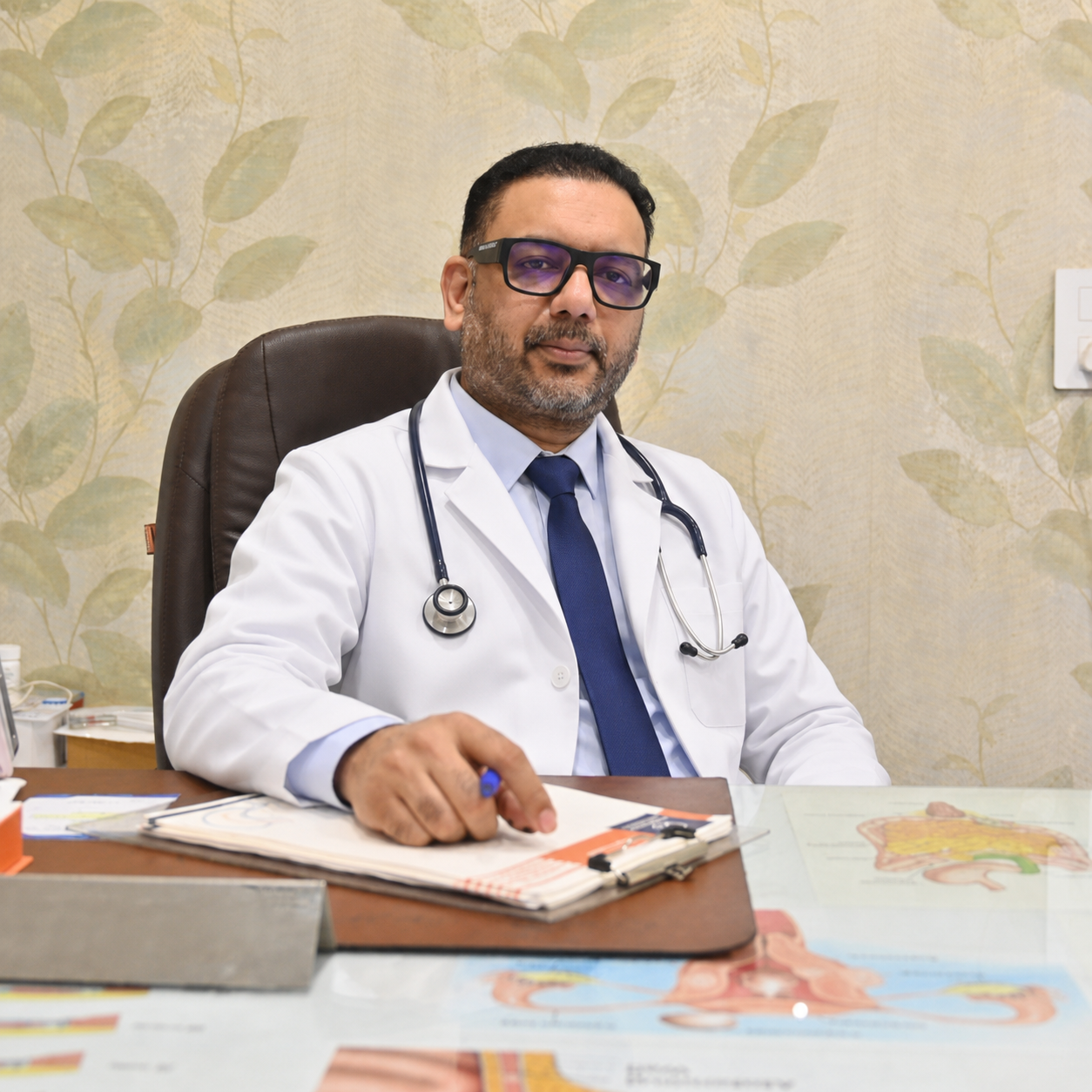
Answer box: Ulcerative colitis and Crohn's disease are long-term inflammation of the bowel, together called IBD. They cause blood in stool, loose motions, belly pain and weight loss. Dr Raman Garg, surgical gastroenterologist at Bombay Gastro & Cancer Institute, Bathinda, Punjab, India, confirms the diagnosis by colonoscopy and plans medicines, and surgery when it is truly needed.
What are ulcerative colitis and Crohn's disease, in plain words?
In both diseases the body's own defence system attacks the lining of the gut by mistake. The lining becomes red, swollen and sore, and ulcers form on it. This is different from IBS, where the bowel looks normal. See our post on IBS vs IBD and the page on IBS treatment.
- Ulcerative colitis (UC): inflammation starts in the rectum and spreads upward through the large bowel (colon) in one continuous stretch. It affects only the inner lining.
- Crohn's disease: inflammation can appear anywhere from the mouth to the anus, most often at the end of the small bowel and in the colon. It appears in patches, with healthy bowel in between, and it can go through the full thickness of the bowel wall.
Both are long-term. They come and go, with active phases (flares) and calm phases (remission). They are not caused by something you ate or by black magic or by a weak stomach. They are not infectious, so the family is not at risk of catching them.
Symptoms and when to worry
Ulcerative colitis often shows as:
- Loose motions with blood or mucus, sometimes 6 to 10 times a day.
- Urgent need to rush to the toilet; potty me khoon.
- Cramping in the lower left belly.
- Tiredness, low haemoglobin.
Crohn's disease often shows as:
- Long-running pain in the lower right belly, sometimes mistaken for appendix.
- Loose motions for weeks, with or without blood.
- Weight loss and loss of appetite.
- Mouth ulcers, fever, painful anal fissure, or a fistula (a tunnel near the anus). See fistula treatment.
- In children and teens: poor growth.
A 27 year old from Maur Mandi with 3 months of loose stool mixed with blood, treated again and again as "infection" with antibiotics, is a common story. The problem is not infection; it is inflammation, and it needs a colonoscopy.
Red flags needing same-day hospital care:
- Heavy bleeding, or more than 8 bloody motions a day.
- High fever with fast heartbeat and severe belly pain.
- A hard, swollen, tender belly or vomiting with no passing of gas or stool.
- Dizziness and weakness from blood loss.
Call +91 82641-60001 immediately. Read about blood in stool treatment.
Causes and risk factors
The exact cause is not known. A mix of things plays a part:
- Immune system: it reacts against the bowel's own lining.
- Genes: having a parent, brother or sister with IBD raises the chance.
- Gut bacteria and environment: changes in diet, repeated antibiotics and infections may trigger it.
- Smoking: raises the risk of Crohn's disease and worsens it.
- Age: most start between 15 and 35, and a second smaller group after 50.
IBD is no longer rare in Punjab. More young people from towns and villages now come in with it, so long loose motions with blood should not be brushed off.
How Dr Raman Garg diagnoses IBD
One test alone cannot prove IBD. Dr Raman Garg puts together your story, examination and a few tests.
- History and examination: pattern of stool, blood, weight, family history, mouth, belly and anal area.
- Stool tests: to rule out infection (amoeba, bacteria) before labelling IBD.
- Blood tests: haemoglobin, infection markers, liver and protein levels.
- Colonoscopy with biopsy: a thin camera tube goes through the back passage and shows the lining. Tiny samples (biopsy) are sent for the microscope. This is the key test.
- Scan: a CT scan of the abdomen, or imaging of the small bowel, when Crohn's is suspected. Arranged with trusted imaging partners in Bathinda, and Dr Raman Garg reviews the report the same day.
| Test | Starting (Rs) | Average (Rs) | Maximum (Rs) |
|---|---|---|---|
| OPD consultation | 500 | 700 | 1,000 |
| Stool routine test | 100 | 150 | 300 |
| Colonoscopy, diagnostic | 4,500 | 7,000 | 12,000 |
| Colonoscopy with biopsy | 7,000 | 10,000 | 18,000 |
| Biopsy report (histopathology), per sample | 800 | 1,500 | 3,000 |
| CT scan abdomen | 3,500 | 6,000 | 9,000 |
| Upper GI endoscopy (for Crohn's of the upper gut) | 2,000 | 3,200 | 5,000 |
| Pre-operative blood tests, ECG and chest X-ray | 1,500 | 2,500 | 4,000 |
Note: These are typical Punjab costs for 2026. The final cost may vary after Dr Raman Garg examines you, depending on how many biopsy samples are taken, which scans are needed, how active the disease is and your health.
Bowel preparation for colonoscopy is done at home the day before; we explain it step by step. See colonoscopy in Bathinda and colonoscopy: who needs it and prep.
Treatment options: medicines first, surgery only when needed
IBD cannot be cured by a tablet course, but it can usually be brought under control for long periods. The aim is to stop the flare, heal the lining, and keep you in remission. Most patients are treated with medicines for life, with regular review. We do not promise a cure.
Medicines
- Aminosalicylates (5-ASA): the first line in mild to moderate UC. Tablets, and enemas or suppositories for the lower bowel.
- Steroids: a short course to settle a strong flare. They are not for long-term use.
- Immune-calming medicines (immunomodulators): used to keep remission and reduce steroid need.
- Biologic medicines: injections or drips for moderate to severe disease or when other medicines fail. The need, the tests before starting (such as TB and hepatitis checks) and the follow-up are explained to you in detail.
- Supportive care: iron, vitamin D, calcium and protein for anaemia and weakness.
Stopping medicines on your own when you feel better is the most common reason for a relapse. Please do not stop them without calling.
Food and lifestyle
- No food causes IBD, but some foods worsen a flare. Take small, frequent, soft meals during a flare: khichdi, curd rice, banana, boiled potato, dal water.
- Reduce raw salad, whole pulses, heavy spices, and fried food while symptoms are active.
- Avoid tobacco; it harms Crohn's disease.
- Avoid painkillers such as diclofenac and ibuprofen unless Dr Raman Garg allows them.
- Keep up protein and fluids. Take vitamin and iron advice from the doctor, not the chemist.
When surgery is needed
Most UC and Crohn's patients never need an operation. Surgery is advised when:
- A flare is so severe that medicines are failing and life is at risk.
- There is heavy, repeated bleeding, a hole (perforation) in the bowel, or a toxic, swollen colon.
- Scarring has narrowed the bowel and caused a blockage (stricture). See intestinal obstruction surgery.
- Abscess or fistula does not heal with medicines.
- Medicines cause serious side effects.
- Changes in the colon lining that can turn cancerous are found in long-standing UC.
Surgery means removing the diseased part of the bowel. In UC, removing the colon removes the disease from the colon. In Crohn's, only the diseased segment is removed, because the disease can return elsewhere. Where possible Dr Raman Garg uses the keyhole (laparoscopic) method for planned surgery, and open surgery where safety needs it. Emergency surgery is done without delay. See laparoscopic surgery in Bathinda.
Before and after: what to expect
| When | What happens |
|---|---|
| First visit | History, examination, stool and blood tests advised, colonoscopy booked |
| Colonoscopy day | Bowel preparation at home, scope under sedation, biopsy taken, home the same day for most patients |
| 3 to 5 days later | Biopsy and test reports reviewed, diagnosis explained, treatment started |
| 4 to 8 weeks | Most patients see fewer motions and less blood; medicines adjusted |
| Every 3 to 6 months | Review, blood tests; scope after a few years to check healing |
| After bowel surgery | Walking on the same or next day for most patients; diet in stages; wound care; phone or video follow-up |
Patients with long-standing UC (about 8 to 10 years or more) need a colonoscopy at regular intervals to check for early cancer changes. Dr Raman Garg sets your schedule.
Risks and how they are handled
IBD itself can cause anaemia, weight loss, bowel blockage, fistula and, rarely over many years, bowel cancer. Medicines can lower body defences, so we check for TB and hepatitis before starting some of them, and we ask you to report fever early. Colonoscopy has small risks of bleeding after a biopsy or, rarely, injury to the bowel wall, explained before the test. Surgery carries general risks such as infection, bleeding and a leak at the join in the bowel, which are reduced by careful preparation, nutrition and technique. Planned surgery after good preparation is much safer than emergency surgery in a very sick bowel, which is one more reason not to delay your first visit.
Cost of IBD care in Bathinda
Most of the long-term cost is for regular medicines and review tests, which vary with the medicine chosen. The test costs are listed above. If surgery is needed, the cost depends on whether it is planned or emergency.
| Surgery | Starting (Rs) | Average (Rs) | Maximum (Rs) |
|---|---|---|---|
| Intestinal obstruction surgery | 60,000 | 1,20,000 | 2,50,000 |
| Emergency surgery for perforation or bleeding | 70,000 | 1,10,000 | 1,80,000 |
Note: These are typical Punjab costs for 2026. The final cost may vary after Dr Raman Garg examines you, depending on how much bowel is affected, whether surgery is planned or an emergency, anaesthesia type, your age and other illnesses and your health.
Planned bowel surgery for IBD is priced after examination and review of your reports, since it varies widely. See gastro treatment cost in Bathinda for the complete list.
Insurance and cashless
Bombay Gastro & Cancer Institute is empanelled with almost all major insurers and TPAs, including Aditya Birla Health Insurance, Niva Bupa, Digit Insurance, Care Health Insurance, Vidal Health TPA, ICICI Lombard, Raksha TPA, Future Generali, SBI General Insurance, Oriental Insurance, Liberty General Insurance, IFFCO Tokio, Cholamandalam MS, Medi Assist TPA, and almost all other major insurers and TPAs. Ayushman Bharat: call us with your card details and our insurance desk will tell you the same day how your card can be used.
- Call or WhatsApp +91 82641-60001 with your policy or card details.
- Our insurance desk checks your cover and the planned procedure.
- The desk arranges pre-authorisation.
- You are treated, and the bill is settled with the insurer as per policy terms.
See cashless insurance for gastro treatment.
Facilities at Bombay Gastro & Cancer Institute
- Advanced endoscopy and colonoscopy suite for scope and biopsy.
- Fully equipped in-house diagnostic laboratory for blood and stool tests.
- Modern laparoscopic operation theatre.
- Stitchless laparoscopic technique with skin glue.
- Same-day walking and discharge within 24 hours for most keyhole surgeries.
- Comfortable patient rooms and 24/7 emergency care support.
- Cashless insurance desk.
- One surgeon from consultation to follow-up.
- Online pre-arrival consultation for out-of-town and NRI patients: share reports on WhatsApp.
- Follow-up by phone or video.
- CT and MRI arranged with trusted imaging partners in Bathinda, reports reviewed by Dr Raman Garg the same day.
More at gastro hospital in Bathinda.
Why patients choose Dr Raman Garg
IBD care needs both a physician's eye and a surgeon's judgement, and the two should talk to each other. Dr Raman Garg is a surgical gastroenterologist: a stomach, gut, liver, gallbladder and pancreas specialist who also operates. He can scope you, read the biopsy, start medicines and, if the bowel fails to respond, operate at the right time, not too early and not too late.
He has 20+ years of experience and 10,000+ laparoscopic surgeries. His training includes MBBS from Government Medical College, Patiala, MS General Surgery from Dayanand Medical College & Hospital, Ludhiana, and DNB Surgical Gastroenterology from Lilavati Hospital and Research Centre, Mumbai. He is a member of IAGES and AMASI and the first surgical gastroenterologist in the Malwa belt of Punjab. See Dr Raman Garg and the page on gastro doctor in Bathinda.
Patients we see from your area
Patients travel from Maur Mandi (30 km, 40 min), Barnala (70 km, 1 hr 30 min), Faridkot (65 km, 1 hr 20 min) and other towns around Bathinda. Because IBD needs follow-up for years, phone or video reviews save repeated long trips once the plan is set.
How to book
- Call or WhatsApp +91 82641-60001 (or +91 99885-03800).
- Send old colonoscopy, biopsy and blood reports on WhatsApp, with the list of current medicines.
- Visit OPD, Monday to Saturday, 10 AM to 5 PM.
- Get tests arranged and a written plan the same day where possible.
Address: Bombay Gastro & Cancer Institute, Power House Road, Near Street No. 10, Bathinda, Punjab 151001, India. Email: bgcibathinda@gmail.com. Sunday: emergency only. Emergency care support 24/7 on +91 82641-60001. Use book an appointment for an online pre-arrival consultation.
This page is general information; your plan is set after Dr Raman Garg examines you.
Related pages
IBS treatment | Blood in stool treatment | Colonoscopy in Bathinda | Fistula treatment | Intestinal obstruction surgery | Blood in stool: causes and when to worry | IBS vs IBD | All gastro treatments
Medically reviewed by Dr Raman Garg
Last updated: 8 November 2026