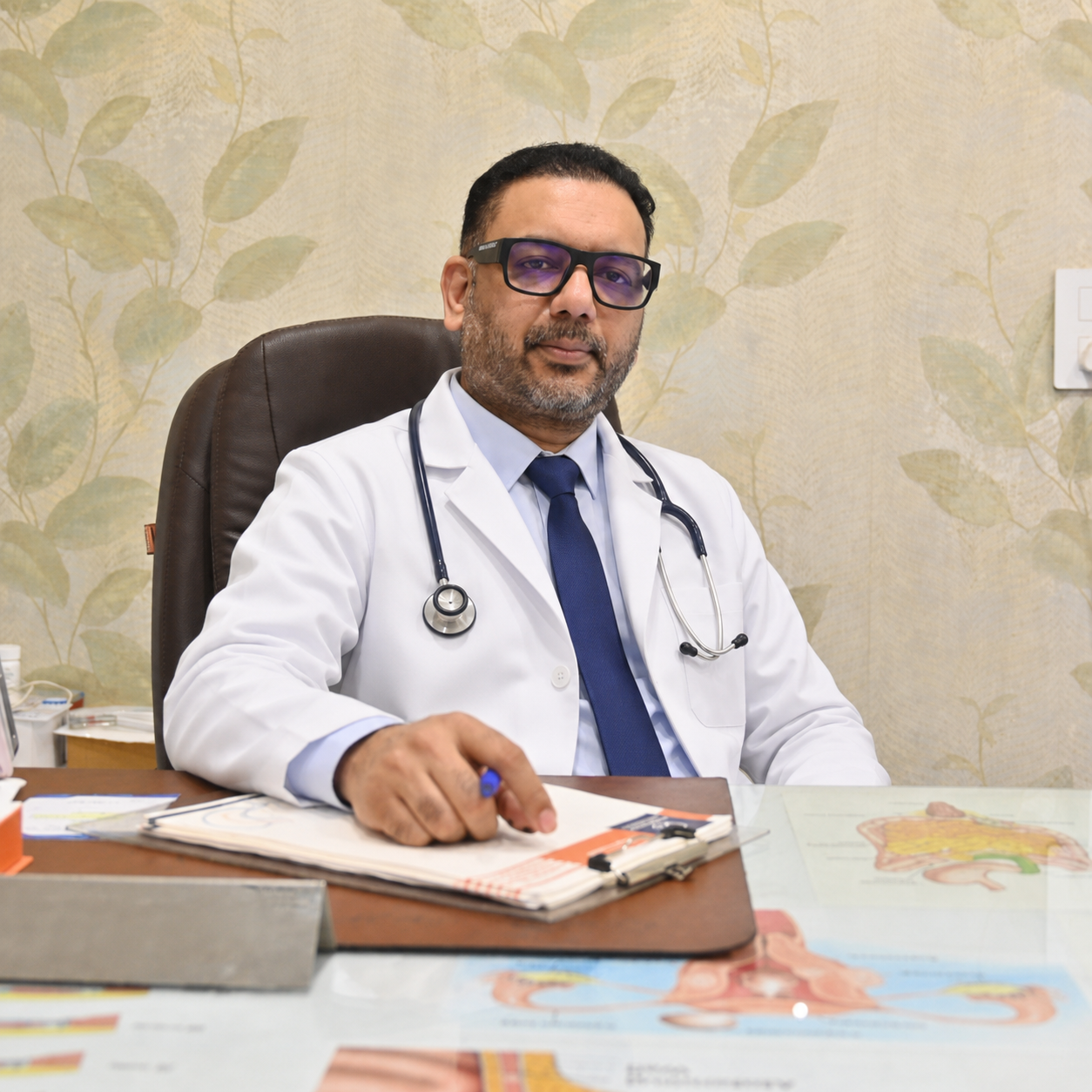
Hernia Treatment and Surgery in Punjab
A hernia occurs when tissue pushes through a weak area in the surrounding muscle or connective tissue. Symptoms, urgency and treatment options differ by hernia type and patient health. Dr. Raman Garg, Senior Surgical Gastroenterologist at Bombay Gastro & Cancer Institute, Bathinda, has 20+ years of experience and has performed 1,000+ laparoscopic hernia repairs.
People considering hernia repair can ask about open and laparoscopic approaches, likely benefits, risks, alternatives and recovery. Incision size, recurrence risk and recovery depend on the hernia, technique, facility and individual health; these should be discussed during a consultation.
Types of Hernia We Treat
Inguinal Hernia: Symptoms and Care
Most common type — groin area. More frequent in men. Tissue pushes through inguinal canal. Repaired with TEP or TAPP laparoscopic technique.
Umbilical Hernia: Symptoms and Care
At the navel/belly button. Common in adults with obesity or previous pregnancies. Laparoscopic repair with mesh.
Incisional Hernia: Assessment and Care
Occurs at site of previous surgery. Can be large. Laparoscopic repair preferred to avoid another large incision.
Femoral Hernia: Symptoms and Care
Below inguinal ligament, more common in women. Higher strangulation risk. Prompt surgical repair recommended.
Hiatal Hernia: Symptoms and Care
Part of stomach pushes through diaphragm. Causes severe GERD. Treated with laparoscopic fundoplication.
Epigastric Hernia: Assessment and Care
Small fatty hernia above navel. Usually small, simple repair.
Sports Hernia: Assessment and Care
Groin injury in athletes with abdominal/thigh pain. Specialized surgical repair.
Obturator Hernia: Assessment and Care
Rare hernia through obturator foramen. Common in elderly thin women. Complex repair.
Hernia Warning Signs
Go to emergency immediately if you have a hernia and notice:
- Hernia becomes hard, tender, and cannot be pushed back (irreducible/incarcerated)
- Overlying skin turns red or blue (strangulated hernia — surgical emergency!)
- Sudden severe pain at the hernia site
- Nausea, vomiting, inability to pass stools/gas
- Fever with hernia pain
Laparoscopic vs Open Hernia Repair
Cities in Punjab We Serve
Patients from these cities and districts regularly visit Dr. Raman Garg's clinic in Bathinda for hernia surgery: